

Interactive Cat Toys for Mental Stimulation
Table of Contents
- Why Interactive Cat Toys Matter for Indoor Cats
- How to Keep Indoor Cats Entertained
- Safe Materials for Cat Toys
- Best Puzzle Feeders for Cats
- Electronic vs. Manual Interactive Toys
- Common Mistakes to Avoid When Selecting Toys
- Conclusion
- Frequently Asked Questions
Last Updated: September 3, 2026
Why Interactive Cat Toys Matter for Indoor Cats
Indoor cats face a fundamental challenge that outdoor cats don't: boredom. Without natural hunting opportunities, environmental variety, or the constant stimulation of the outdoor world, indoor cats can develop behavioral problems, weight gain, and anxiety. This is where interactive cat toys for mental stimulation become essential.
Interactive play activates a cat's predatory drive, the instinctive hunting behaviors that define feline psychology. When cats engage with interactive toys, they're not just having fun. They're satisfying deep biological needs. A cat that lacks adequate mental and physical stimulation often becomes destructive, overweight, or withdrawn. The stakes are higher than most pet parents realize.
At My Store, we understand that the right toys transform indoor cat life. Interactive cat toys for mental stimulation aren't luxuries, they're necessities for behavioral health, weight management, and stress reduction. Cats that receive regular interactive play show improved cognitive function, better emotional regulation, and fewer destructive behaviors. The difference between a bored cat and an enriched one is often the difference between a content pet and a frustrated one.
This guide covers everything you need to know about selecting and using interactive cat toys for mental stimulation. We'll explore how these toys work, what makes them safe, which types deliver the best results, and the common mistakes that undermine your efforts.
How to Keep Indoor Cats Entertained
Keeping an indoor cat entertained requires understanding what drives them. Cats are predators by nature, and interactive toys tap directly into the hunting sequence: stalking, pouncing, and capturing prey. Without this outlet, indoor cats become restless and anxious.
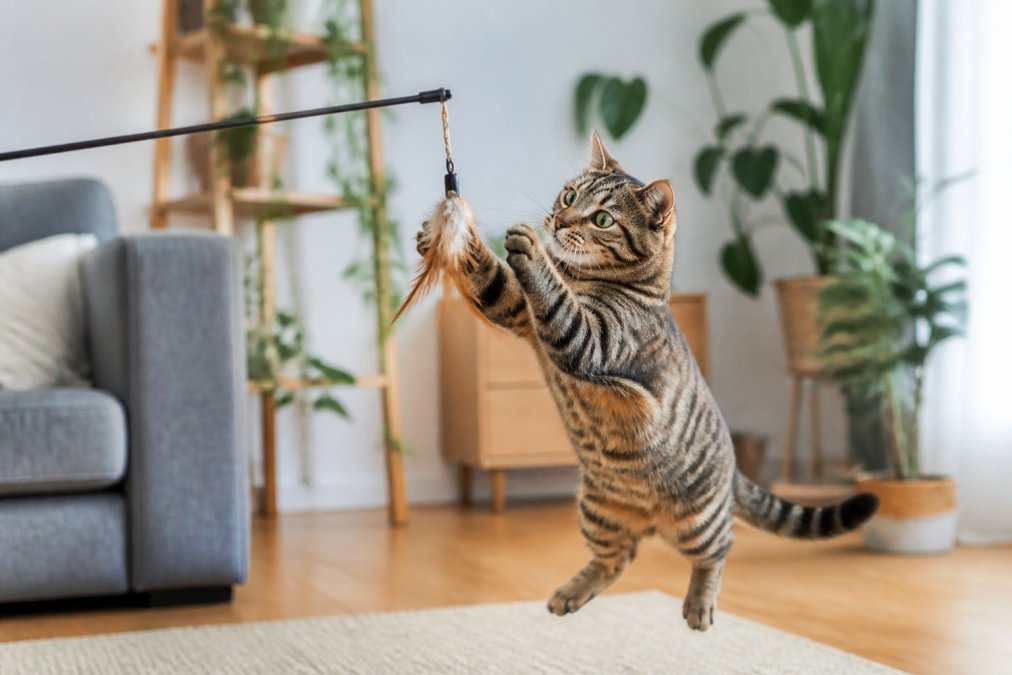
The most effective approach combines multiple toy types and play sessions. Wand toys, those with feathers, strings, or small attachments on the end of a stick, are particularly powerful because they mimic the erratic movement of prey. When you control the toy's movement, you're essentially orchestrating a hunting scenario. Cats respond with intense focus and physical exertion.
Puzzle feeders represent another critical category. These toys slow down eating and force cats to work for their food, providing both mental stimulation and behavioral enrichment. A cat that spends 20 minutes extracting kibble from a puzzle feeder receives the same cognitive engagement as a wild cat solving the problem of catching dinner.
Activity boards and climbing structures add environmental enrichment. Cats need vertical space, hiding spots, and varied surfaces to explore. A multi-level cat tree with different textures, carpet, sisal, wood, engages multiple senses and encourages natural behaviors like scratching and climbing.
Automated toys create engagement even when you're not home. Laser pointers, motion-activated toys, and rolling balls provide unpredictable stimulation that holds a cat's attention. However, automated toys work best as supplements to interactive play, not replacements. A cat needs the satisfaction of actually catching something occasionally.
Play session duration matters. Most cats benefit from two 10-15 minute sessions daily, though some high-energy cats need more (aafco.org). The key is consistency. Cats thrive on routine, and regular play sessions become part of their daily rhythm.
Safe Materials for Cat Toys
The materials in cat toys directly affect your pet's safety. Cats chew, swallow, and ingest toy components, so material selection isn't just about durability, it's about preventing intestinal blockages, toxicity, and injury.
Non-toxic, pet-safe materials are non-negotiable. Canvas, natural rubber, sisal rope, and untreated wood are excellent choices because they're digestible if swallowed in small quantities and won't cause poisoning (aspca.org). Avoid toys with plastic beads, foam filling, or synthetic materials that can cause intestinal obstruction.
Durability directly correlates with safety. A toy that falls apart quickly becomes a choking hazard. This is why reinforced stitching, strong seams, and high-quality construction matter. The Bite-Resistant Cartoon Pet Dog Toy from My Store, for example, uses durable canvas construction specifically designed to withstand aggressive play without tearing or shedding fibers.

Avoid toys with small detachable parts, bells, buttons, or plastic eyes that can be chewed off and swallowed. String-based toys require supervision because cats can ingest string, leading to serious intestinal damage. Never leave string toys unattended.
Look for toys without toxic dyes or chemicals. Some inexpensive toys use dyes that bleed or contain heavy metals. If a toy smells strongly chemical or has an odd odor, it's worth avoiding.
Catnip and silvervine are natural plant materials that are safe for cats. Unlike synthetic alternatives, natural plant-based attractants won't cause digestive issues if ingested. However, some cats have sensitivities, so monitor your cat's response to catnip-infused toys.
Regular inspection prevents accidents. Check toys weekly for damage, loose seams, or pieces coming apart. Replace any toy showing wear. A toy that was safe last month might develop sharp edges or loose components over time.
Best Puzzle Feeders for Cats
Puzzle feeders represent one of the highest-impact categories of interactive cat toys for mental stimulation. They slow eating, engage cognitive function, and reduce boredom simultaneously.
The best puzzle feeders share common characteristics: they're challenging enough to hold a cat's attention but not so difficult that they cause frustration. A cat should be able to extract food within 5-10 minutes of attempting the puzzle, not spend 30 minutes struggling unsuccessfully (peer-reviewed research).
Tiered difficulty levels work best. Start with simpler designs that require just rolling or pushing to access kibble. As your cat masters the puzzle, graduate to more complex versions with multiple compartments or hidden chambers. This progression keeps the toy mentally engaging over time rather than becoming routine.
Adjustable difficulty is a feature worth seeking. Some puzzle feeders allow you to increase the challenge by closing off easier access points, forcing your cat to work harder as they improve. This maintains engagement long-term.
Material matters for puzzle feeders especially. They're used frequently and often dropped or chewed. Durable plastic, reinforced wood, or heavy-duty rubber ensures the toy survives weeks of daily use. Avoid thin plastic that cracks easily or has sharp edges when broken.
Cleaning accessibility is practical but often overlooked. A puzzle feeder with crevices and hidden chambers can harbor kibble dust and bacteria. Look for designs where all food-contact surfaces are accessible for washing. Dishwasher-safe options simplify maintenance.
Interactive feeders that dispense food slowly, through rolling, tilting, or pushing mechanisms, also reduce the risk of overeating and vomiting. Cats that eat too quickly often regurgitate. A puzzle feeder naturally paces consumption.
Size matters. The feeder should be appropriately sized for your cat. Too small and it's frustrating; too large and it's awkward to manipulate. Most cats prefer puzzle feeders they can comfortably bat and roll with their paws.
Electronic vs. Manual Interactive Toys
The choice between electronic and manual interactive cat toys for mental stimulation depends on your lifestyle, your cat's personality, and your goals.
Manual toys, wand toys, balls, and interactive strings, require active participation from you. You control the movement, speed, and prey-like behavior. This direct interaction strengthens the bond between you and your cat while allowing you to read your cat's engagement level and adjust intensity accordingly. Manual toys also provide the most authentic hunting simulation because the unpredictability comes from a living player, not a programmed pattern.
The downside of manual toys is obvious: they require your time. If you work long hours, manual play sessions might be limited to mornings and evenings. For some cats, this is sufficient. For others, it leaves them under-stimulated during the day.
Electronic toys fill the gap when you're away. Automated laser toys, motion-activated rolling balls, and robotic mice provide stimulation without human involvement. Some cats become obsessed with laser pointers, chasing the beam for extended periods. Others lose interest quickly. Individual personality matters significantly.
Electronic toys with automatic shut-off features are preferable to those that run continuously. A toy that activates for 10 minutes then rests prevents overstimulation and excessive battery drain. Toys that randomly activate throughout the day provide unpredictability, which maintains engagement better than predictable patterns.
The hybrid approach works best for most households. Use manual interactive toys for dedicated play sessions, those 10-15 minute daily interactions that strengthen your relationship and provide intense stimulation. Supplement with electronic toys for background enrichment when you're working, sleeping, or away from home.
One critical caveat: some cats become frustrated by electronic toys they can't fully "catch." A laser pointer, for instance, never allows the cat to actually capture the prey. This can lead to stress rather than satisfaction. If your cat seems frustrated rather than engaged, electronic toys might not be the right fit.
Battery life and durability matter for electronic toys. A toy that dies after a week of use is wasteful and disappointing. Look for toys with extended battery life or rechargeable options. Durability ensures the toy survives drops, rough play, and moisture.
Common Mistakes to Avoid When Selecting Toys
Most pet parents make predictable mistakes when choosing interactive cat toys for mental stimulation. Understanding these pitfalls helps you invest wisely and avoid wasting money on toys your cat ignores.
The first mistake is buying toys based on appearance rather than function. A toy that looks cute to humans might hold zero appeal for your cat. Cats care about movement, texture, and how a toy responds to their paws, not color or design. A plain wand toy with simple feathers often outperforms an expensive toy with bells and ribbons if the movement is more engaging.
Assuming all cats like the same toys is another common error. Some cats are obsessed with catnip; others are completely indifferent. Some love fast, erratic movement; others prefer slow, deliberate motion. Some cats are bold hunters; others are cautious stalkers. Personality varies enormously. The toy that mesmerizes one cat might bore another completely.
Neglecting play session consistency undermines everything. Buying ten interactive toys doesn't help if you only play with your cat once a week. Consistency matters more than quantity. Two 15-minute daily sessions with basic toys deliver better results than sporadic sessions with expensive equipment. Establish a routine and stick to it.
Leaving toys out constantly causes habituation. Cats lose interest in toys they see all day. Rotating toys, putting some away and introducing them periodically, maintains novelty and engagement. A toy your cat ignored for two weeks suddenly becomes fascinating when you bring it back out.
Ignoring safety in favor of price is dangerous. The cheapest toy often has the worst construction, toxic dyes, and loose parts. Spending an extra few dollars on a quality toy from a reputable retailer prevents veterinary emergencies. My Store's Bite-Resistant Cartoon Pet Dog Toy at $14.98 represents good value because it's built for durability and uses safe canvas materials, not because it's the cheapest option available.
Assuming electronic toys replace human interaction is a critical mistake. Cats need interactive play with their humans. Electronic toys supplement but never replace the engagement, bonding, and behavioral benefits of direct play. A cat that only has electronic toys available is under-enriched emotionally, even if mentally stimulated.
Buying toys that are too advanced causes frustration rather than engagement. A puzzle feeder so complex that your cat gives up after two attempts creates stress, not satisfaction. Start simple and progress gradually. A frustrated cat is worse off than an under-stimulated one.
Neglecting toy maintenance shortens lifespan and creates safety hazards. Toys with loose seams, torn fabric, or broken pieces become choking risks. Weekly inspection and prompt replacement of damaged toys prevents accidents.
| Mistake | Impact | Solution |
|---|---|---|
| Choosing by appearance | Cat ignores toy | Select based on movement and texture |
| Assuming universal preferences | Wasted money | Test different types to match personality |
| Inconsistent play sessions | Under-stimulation, behavior issues | Establish daily 15-minute routine |
| Leaving toys out constantly | Habituation and boredom | Rotate toys weekly |
| Prioritizing price over quality | Safety hazards, quick deterioration | Invest in durable, tested toys |
| Relying only on electronic toys | Reduced bonding, incomplete enrichment | Combine electronic and manual play |
| Overly complex puzzles | Frustration and stress | Start simple, increase difficulty gradually |
| Ignoring toy damage | Choking hazards, intestinal blockage | Inspect weekly, replace immediately |
Conclusion
Interactive cat toys for mental stimulation aren't optional extras, they're foundational to indoor cat health. Cats evolved as hunters, and without appropriate outlets for that predatory drive, they develop behavioral problems, anxiety, and weight issues. The right toys, used consistently, transform a cat's quality of life.
The best approach combines manual interactive play with puzzle feeders and environmental enrichment. Wand toys provide intense hunting simulation. Puzzle feeders engage cognitive function while slowing eating. Electronic toys fill gaps when you're away. Variety prevents habituation and keeps your cat engaged long-term.
Safety matters as much as engagement. Choose toys made from non-toxic, durable materials. Inspect regularly. Replace damaged toys immediately. Quality toys from reputable retailers cost more upfront but prevent veterinary emergencies and last longer.
At My Store, we've designed products specifically for cats that need real engagement. Our Bite-Resistant Cartoon Pet Dog Toy uses durable canvas construction that withstands aggressive play while remaining completely safe for your cat. It's the kind of toy that holds up to weeks of daily use without falling apart or shedding dangerous fibers. Shop Pet Essentials Now and discover toys that deliver both mental stimulation and peace of mind.
=== FAQ ANSWERS (audit these too, same rules) ===
[1] Q: What are the best interactive cat toys for mental stimulation? A: The best interactive cat toys combine sensory stimulation with physical activity. Wand toys trigger the chase instinct and prey sequence, while puzzle feeders engage cognitive function during mealtime. Electronic motion toys and activity boards provide sustained engagement. Look for toys with replenishable attachments, non-toxic materials, and adjustable difficulty levels. Rotate toys weekly to maintain novelty and prevent boredom.
[2] Q: Are battery-operated cat toys safe for unsupervised play? A: Most battery-operated toys are safe for unsupervised play if they feature automatic shut-off after 15-30 minutes and have no small detachable parts. Check that toys use non-toxic materials and have no exposed wires. Supervise play initially to ensure your cat doesn't chew through cords or damage the toy. Remove toys if you notice damage.
[3] Q: How often should I rotate my cat's toys to keep them interested? A: Rotate toys every 7-10 days to maintain engagement and prevent habituation. Store unused toys in a closed container so they feel 'new' when reintroduced. Most cats respond well to having 3-4 toys available at any time, with the rest in rotation. This approach keeps play sessions fresh and sustains mental stimulation without overwhelming your cat or creating clutter in your home.
[4] Q: Do interactive cat toys actually help with anxiety and stress reduction? A: Yes. Interactive play reduces stress by channeling predatory drive and providing physical activity that prevents sedentary behavior. Puzzle feeders and activity boards engage cognitive function, which can reduce anxiety-related behaviors. Consistent engagement through interactive toys supports both emotional and physical well-being.
Frequently Asked Questions
What are the best interactive cat toys for mental stimulation?
The best interactive cat toys combine sensory stimulation with physical activity. Wand toys trigger the chase instinct and prey sequence, while puzzle feeders engage cognitive function during mealtime. Electronic motion toys and activity boards provide sustained engagement. Look for toys with replenishable attachments, non-toxic materials, and adjustable difficulty levels. Rotate toys weekly to maintain novelty and prevent boredom.
Are battery-operated cat toys safe for unsupervised play?
Most battery-operated toys are safe for unsupervised play if they feature automatic shut-off after 15-30 minutes and have no small detachable parts. Check that toys use non-toxic materials and have no exposed wires. Supervise play initially to ensure your cat doesn't chew through cords or damage the toy. Remove toys if you notice damage.
How often should I rotate my cat's toys to keep them interested?
Rotate toys every 7-10 days to maintain engagement and prevent habituation. Store unused toys in a closed container so they feel 'new' when reintroduced. Most cats respond well to having 3-4 toys available at any time, with the rest in rotation. This approach keeps play sessions fresh and sustains mental stimulation without overwhelming your cat or creating clutter in your home.
Do interactive cat toys actually help with anxiety and stress reduction?
Yes. Interactive play reduces stress by channeling predatory drive and providing physical activity that prevents sedentary behavior. Puzzle feeders and activity boards engage cognitive function, which can reduce anxiety-related behaviors. Consistent engagement through interactive toys supports both emotional and physical well-being.
Interactive cat toys for mental stimulation require thoughtful selection, consistent use, and attention to safety. Your cat's behavioral health, weight management, and emotional well-being depend on it. Start with quality toys, establish a daily play routine, and adjust based on your cat's individual personality. The investment in proper enrichment pays dividends in a happier, healthier, more content cat.
This article was written using GrandRanker