

6 Ways to Help an Anxious Dog Sleep Better Tonight
Table of Contents
- Why Your Anxious Dog Won't Sleep (And What's Really Going On)
- Dog Sleep Anxiety Symptoms: How to Tell Restlessness From Real Distress
- 1. Build a Bedtime Routine for Anxious Dogs That Never Changes
- 2. Choose Calming Dog Beds for Anxiety That Feel Like a Den
- 3. Tire Out the Body Before Lights Out
- 4. Quiet the Room: Noise, Light, and Temperature Fixes
- 5. Calming Supplements, Pheromones, and Touch: What Vets Actually Approve
- 6. Handle the Hard Cases: Senior Dogs, Rescue Dogs, and Nighttime Anxiety
- Your 7-Night Sleep Reset Checklist
- Frequently Asked Questions
Last Updated: September 24, 2026
Why Your Anxious Dog Won't Sleep (And What's Really Going On)
An anxious dog sleep problem rarely starts at bedtime. It builds all day. This guide from My Store breaks down six practical ways to help an anxious dog sleep better, starting tonight.
Dogs are crepuscular by nature, which means their internal clock nudges them toward activity at dawn and dusk. When anxiety overrides that rhythm, the result is a dog who paces the hallway at 2 a.m. while you lie awake listening. The American Veterinary Medical Association's pet behavior resources notes that anxiety disorders are among the most common behavioral issues veterinarians diagnose, and disrupted sleep is often the first visible sign.
Here's what most guides get wrong: they treat nighttime restlessness as a training problem. It's usually an environment problem, a health problem, or both. Below, we'll show you exactly how to tell the difference and what to do about each one.
Dog Sleep Anxiety Symptoms: How to Tell Restlessness From Real Distress
Dog sleep anxiety symptoms fall into two categories: behavioral signs that respond to routine changes, and physical signs that need a veterinarian's eyes. Knowing which one you're looking at saves weeks of trial and error.
Nighttime Signs That Point to Anxiety, Not Just Energy
A dog with leftover energy will eventually settle. A dog with anxiety usually won't, no matter how tired they are.
Watch for these patterns:
- Pacing and panting in a room that isn't warm
- Circling the bed repeatedly without lying down
- Whining or barking at the same time each night
- Destructive chewing focused on doors, crates, or your belongings
- Shadowing you from room to room after dark
- Standing at the door or window, alert and rigid
Separation anxiety often shows up hardest at night because that's when the household goes quiet and your dog feels most alone. If the behavior only happens when you leave the room, that's your clue.
When Pacing and Panting Means It's Time to Call Your Vet
Call your veterinarian if the restlessness is new, sudden, or comes with any of these:
- House soiling in a previously reliable dog
- Weight loss, appetite changes, or increased drinking
- Stiffness, limping, or trouble getting up
- Disorientation, staring at walls, or getting stuck in corners
- Panting that continues while resting
Pain and hormonal conditions can both masquerade as anxiety. A veterinary consultation rules those out before you spend money on beds and supplements that won't help.
1. Build a Bedtime Routine for Anxious Dogs That Never Changes
A bedtime routine for anxious dogs works because predictability lowers cortisol levels. Dogs can't read clocks, but they read sequences. Same walk, same last potty break, same treat, same bed, every night.
The mistake most often made is a routine that's elaborate for three nights and then abandoned. Consistency matters more than content. A simple four-step sequence repeated nightly beats a complicated one that can't be sustained.
Try this framework:
- Final potty break at the same time each night
- A short, calm walk or gentle indoor play session
- A quiet wind-down with dim lights and no roughhousing
- A small calming treat in the bed, lights out
Keep the last 30 minutes low-stimulation. No fetch, no visitors, no loud television. If your dog sleeps in a crate, the crate becomes step four.
2. Choose Calming Dog Beds for Anxiety That Feel Like a Den
Calming dog beds for anxiety work by mimicking a den: enclosed on three sides, soft underfoot, and small enough to feel secure. A wide-open bed in the middle of a room gives an anxious dog nowhere to hide.
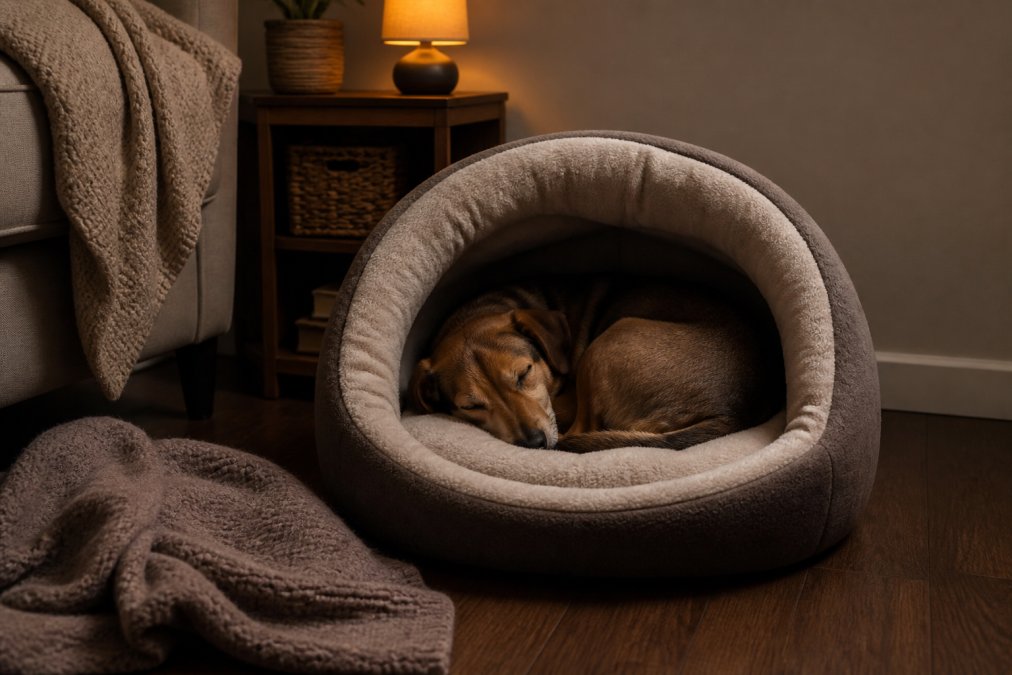
Semi-Enclosed and Round Shapes That Mimic a Safe Space
The physics here is simple. A dog that can rest its back against a wall or a raised edge settles faster. That's why semi-enclosed and round designs outperform flat mats for nervous sleepers.
What many guides miss is sizing. A bed that's too large defeats the purpose. Your dog should be able to curl fully inside the rim with a little room to spare, not sprawl across an open field of fabric.
For den-style options, the All-Season Semi-Enclosed Dog House at My Store comes in four sizes from M to XXL, with a machine-washable cover and an assembly-free setup. Sizes range from 50 x 40 x 10 cm for dogs under 15 lbs up to 90 x 75 x 11 cm for dogs up to 50 lbs. The raised rim gives your dog something to press against, which is the whole point.

If your dog prefers to burrow rather than lean, the Half-Enclosed Winter Dog Bed is flannel-lined with a 40 cm to 60 cm diameter and suits dogs under 30 lbs. For larger breeds with joint issues, the Round Plush Winter Pet Bed scales all the way up to a 120 cm diameter for dogs up to 130 lbs, with a non-slip bottom that keeps the bed from sliding when your dog circles before lying down.
| Bed Style | Best For | Size Range | Key Feature |
|---|---|---|---|
| Semi-Enclosed Dog House | Dogs who lean against edges | 50-90 cm length | Machine washable, assembly-free |
| Half-Enclosed Winter Bed | Burrowers under 30 lbs | 40-60 cm diameter | Flannel lining, removable pad |
| Round Plush Winter Bed | Large breeds, joint support | 40-120 cm diameter | Non-slip bottom, deep cushion |
| Square Plush Dog Bed | Flat sleepers, all sizes | 43-80 cm length | Moisture-proof Oxford base |
Place the bed in a corner, against a wall, or inside a crate. Position matters as much as the product.
3. Tire Out the Body Before Lights Out
Physical exhaustion is the cheapest sleep aid you have. A dog that's had real exercise falls asleep faster and wakes less often.
The catch is timing. Hard exercise within an hour of bedtime backfires, leaving your dog wired and panting. Aim to finish the main activity two to three hours before lights out, then let the evening wind down naturally.
What counts as real exercise depends on your dog:
Sweet Cozy Cat Bed Cave – Washable →
- High-energy breeds: 45-60 minutes of brisk walking, running, or structured fetch
- Senior dogs: 20-30 minutes of sniff-heavy walking, which tires the brain as much as the body
- Flat-faced breeds: shorter, gentler sessions with close attention to breathing
- Reactive dogs: lower-traffic routes or backyard play to avoid stress triggers
Mental work counts too. A puzzle feeder, a snuffle mat, or a training session with positive reinforcement drains energy without overstimulating a nervous dog.
4. Quiet the Room: Noise, Light, and Temperature Fixes
Environmental noise and light pollution are often overlooked causes of nocturnal restlessness in dogs. A dog's hearing range extends well above and below ours, and their eyes are far more sensitive to low light, so the refrigerator hum, the HVAC click, or a neighbor's porch light that you tune out can register as a threat cue all night.
Sound: Mask the Spikes, Don't Just Add Volume
The problem isn't steady sound, it's sudden spikes. A dog sleeping through a fan will still bolt upright at a car door slamming two houses down. The fix is masking, not silencing.
- White, pink, or brown noise machines placed near the sleep area smooth out the sharp transitions that wake a dog. Brown noise (lower frequency, more rumble) tends to work better than bright white noise for dogs who startle at high-pitched sounds.
- A box fan or air purifier on low does double duty: consistent airflow plus a steady low-frequency hum. This is often the cheapest effective fix.
- Acoustic panels or heavy curtains on shared walls help in apartments or townhomes where you can't control the noise source.
- Avoid leaving a TV or talk radio on. Human voices and unpredictable laugh tracks create more startle events than they mask.
Light: Match the Room to the Dog's Age
Light guidance splits by age, and most guides miss this.
- Adult dogs with normal vision: blackout curtains or a fitted crate cover eliminate the sweep of headlights and early summer sunrises that reset a dog's sleep cycle. Total darkness is usually fine.
- Senior dogs and dogs with vision loss: a dim, warm-toned nightlight near the floor often helps more than total darkness. Dogs with cognitive dysfunction or failing eyesight can wake disoriented in a pitch-black room and pace until they find a wall. A low nightlight gives them a reference point without disrupting melatonin.
- Avoid blue-white LEDs in the sleep area. Warm amber or red nightlights are less likely to suppress melatonin in dogs, the same principle that applies to human sleep hygiene.
Temperature: Cool Room, Warm Bed
Dogs sleep best in a room that's slightly cool, roughly 60-70°F, with a warm bed to curl into. That combination lets them regulate their own comfort by shifting position rather than waking you up to adjust the thermostat. Avoid placing the bed directly over a heating vent or in front of a drafty door, both create temperature swings that fragment sleep.
A 3-Night Environmental Audit
Before you buy anything, run this test:
- Night 1: Sit quietly in the sleep area with the lights off for 10 minutes. Write down every sound and light source you notice.
- Night 2: Add one masking sound source and one light fix. Note how long your dog takes to settle.
- Night 3: Adjust temperature and bed placement. Compare settle time and nighttime wake-ups to Night 1.
Most owners find one or two fixes do the heavy lifting. Sleep hygiene for dogs mirrors sleep hygiene for people: dark, quiet, cool, and consistent, but the thresholds are different.
5. Calming Supplements, Pheromones, and Touch: What Vets Actually Approve
Calming supplements and pheromone diffusers can help, but they work best as support for the other five steps, not as a replacement for them. No supplement fixes an unsafe sleep space or an untreated medical problem. What separates a useful supplement plan from wasted money is matching the mechanism to the problem.
Match the Mechanism to the Problem
Different aids work on different systems. Picking the wrong one is why owners conclude "supplements don't work."
- Pheromone diffusers and collars mimic the calming scent a mother dog produces. Best for situational anxiety, new environments, thunderstorms, crate training, rather than chronic nighttime distress. They take a few days of continuous use to build effect, so plug one in a week before you need it.
- Melatonin is a sleep-cycle regulator, not a sedative. It's most useful for short-term disruptions like travel, daylight shifts, or a dog whose schedule was recently upended. Often used short-term rather than indefinitely.
- L-theanine is an amino acid found in green tea that raises calming neurotransmitter activity without sedation. It's the most common active in calming chews because it doesn't knock a dog out, it takes the edge off. Effects are subtle and cumulative over a few days.
- Valerian root and chamomile are mild herbal sedatives. Generally well tolerated, but they can interact with other medications, so disclose them to your vet.
- CBD oil has the widest quality variation of anything on this list. If you try it, look for a product with a published certificate of analysis from an independent lab.
A Decision Framework, Not a Shopping List
Ask three questions before adding anything:
- Is the anxiety situational or chronic? Situational points to pheromones or short-term melatonin. Chronic points to routine, environment, and a vet visit first.
- Is the goal faster sleep onset or fewer wake-ups? Melatonin and L-theanine help with onset. Fewer wake-ups usually means an environmental or medical fix, not a supplement.
- What's already in the dog's system? Stacking a calming chew, melatonin, and CBD is not additive, it's a dosing risk. One aid at a time, one week minimum, then reassess.
Aromatherapy: Real Caveats
Dogs have sensitive noses, and essential oils that calm humans can irritate dogs. Never apply oils directly to your dog's coat or bedding without veterinary guidance. Diffused oils in a well-ventilated room are lower risk than topical application, but some oils, tea tree, citrus, peppermint, and eucalyptus among them, are toxic to dogs even in small amounts. If you want to try aromatherapy, ask your vet which oils are safe for your dog's size and health status before diffusing anything.
Touch: The Free Intervention Most Owners Skip
Massage therapy and physical touch are free and effective, and they work on the same nervous system the supplements target.
- Slow effleurage, long, gentle strokes along the spine and shoulders, lowers arousal. Aim for one stroke every two to three seconds; fast petting does the opposite.
- Ear and paw massage targets areas dense with nerve endings and often produces a visible relaxation response within a minute or two.
- A weighted blanket designed for dogs applies light, even pressure similar to a thunder shirt. Start with short supervised sessions and remove it if your dog tries to wriggle out, a trapped dog becomes a more anxious dog.
6. Handle the Hard Cases: Senior Dogs, Rescue Dogs, and Nighttime Anxiety
Some dogs need more than routine and a good bed. Senior dogs and rescue dogs carry specific challenges that generic advice doesn't cover.
Cognitive Dysfunction in Senior Dogs
Cognitive dysfunction syndrome affects aging dogs much like dementia affects older adults (pubmed.ncbi.nlm.nih.gov). It disrupts the sleep cycle directly, which is why many senior dogs pace at night even in a familiar home.
Rescue Dogs and Post-Traumatic Stress
Rescue dogs often arrive with a history you can't see. Post-traumatic stress and slow acclimation are real, and they show up most at night when the house is quiet and there's nothing to distract from old stress triggers.
Your 7-Night Sleep Reset Checklist
Work through this checklist one night at a time. Give each change a full week before adding the next.
- Night 1: Set a fixed bedtime and write down your four-step routine
- Night 2: Move the bed to a corner or against a wall
- Night 3: Add white noise and block outside light
- Night 4: Shift exercise to 2-3 hours before bed
- Night 5: Add a puzzle feeder or 15 minutes of nose work in the evening
- Night 6: Introduce a calming treat or pheromone in the bed at the same time
- Night 7: Log what changed. Note pacing, panting, and how long your dog took to settle
Frequently Asked Questions
What are the signs of anxiety in dogs at night?
Watch for pacing and panting when the house is quiet, circling the bed without settling, whining at your bedroom door, destructive chewing overnight, or a dog that wakes repeatedly and can't resettle. These dog sleep anxiety symptoms look different from simple restlessness because they repeat night after night. If your dog also trembles, drools, or bolts at ordinary sounds, that points to anxiety rather than leftover energy. Keep a short log of what you see and when, since patterns help your vet decide whether it's behavioral or medical.
Can a comfortable bed help a dog with anxiety?
Yes, and it's often the easiest first change. Calming dog beds for anxiety work by giving a dog a defined, enclosed space that mimics the den instinct, which lowers arousal at bedtime. Semi-enclosed and round plush designs with raised edges let a dog curl and feel covered rather than exposed. The All-Season Semi-Enclosed Dog House, for example, comes in sizes from M (fits dogs up to 15 lbs) through XXL (up to 50 lbs) and is machine washable, so a nervous dog always has a clean, familiar spot to settle into.
Does a consistent routine help anxious dogs sleep?
Consistency does more for anxious dogs than most owners expect. A bedtime routine for anxious dogs works because it removes uncertainty: the same walk, the same last potty break, the same dim lights, the same bed, at roughly the same time each night. Dogs read order, not clocks. When the sequence never changes, the body starts anticipating sleep instead of staying alert for surprises. Aim for a 30 to 45 minute wind-down window, and keep weekend timing close to weekday timing so you don't undo the pattern.
Are there natural ways to calm a dog for sleep?
Several options exist, but run them past your vet first. Pheromone diffusers, weighted blankets, massage, and gentle pressure wraps have few downsides and can be layered with routine changes. Calming supplements containing chamomile, valerian root, or CBD oil are widely sold, but dosing matters, so a veterinary consultation should set the amount. Never give a dog a human sleep aid. If natural aids alone don't work within two weeks, that's your signal to book an exam.
When should I see a vet for my dog's sleep anxiety?
Book an appointment if the sleeplessness has lasted more than two weeks, if your dog's daytime behavior has changed, or if new symptoms appear such as house soiling, disorientation, staring at walls, or uncharacteristic irritability. Senior dogs showing those signs may have cognitive dysfunction rather than plain anxiety, and that needs a different plan. Sudden onset in an otherwise calm dog also warrants a check, since pain, thyroid issues, and other medical problems can look exactly like nighttime anxiety.