

How to Introduce Puzzle Toys to Dogs for Beginners
Table of Contents
- Why Puzzle Toys Matter: Mental Stimulation for Dogs
- What You'll Need Before You Start
- How to Choose the Right Puzzle Toy for Your Beginner Dog
- Step-by-Step: How to Introduce a Puzzle Toy to Your Dog
- Managing Frustration: What to Do When Your Dog Gives Up
- Choosing the Right Treats and Durable Toys for Aggressive Chewers
- How to Keep Dogs Busy: Rotation, DIY Puzzles, and Daily Routines
- Supervision, Safety, and Cleaning Your Puzzle Toys
- Frequently Asked Questions
Last Updated: September 16, 2026
Why Puzzle Toys Matter: Mental Stimulation for Dogs
Mental stimulation for dogs is the deliberate use of problem-solving activities, scent work, and interactive play to engage a dog's brain the way physical exercise engages its body. Puzzle toys deliver that stimulation through treat-dispensing mechanisms that reward sniffing, pawing, and nudging. This guide from My Store covers how to introduce puzzle toys to dogs for beginners, from picking the right first puzzle to knowing when to increase difficulty.
The core problem is simple: a dog that gets two walks a day but no cognitive work is still under-exercised. Physical tiredness and mental tiredness are different states, and most behavioral issues that owners label as stubbornness trace back to boredom. A twenty-minute puzzle session can tire a dog more thoroughly than a long walk because it works a different system entirely.
What Mental Stimulation Actually Does for Your Dog
Cognitive development in dogs depends on novelty and problem-solving, not repetition. When a dog works out how to nose a slider to release a treat, it practices frustration tolerance, impulse control, and reward-based learning all at once. That is behavioral enrichment in its most practical form.
What You'll Need Before You Start
Before you introduce anything, gather four things: a puzzle toy appropriate to your dog's size, high-value treats small enough to fit the toy's compartments, a quiet space with minimal distraction, and a few minutes of patience. That last one matters more than beginners expect.
A common mistake is starting with a puzzle that is too hard. Dogs that fail repeatedly learn that puzzles are frustrating, not fun, and that association is difficult to undo. Start easier than you think you need to.
Here is what to have on hand:
- A beginner-level treat-dispensing toy or slow feeder
- Soft and chewy treats cut into pea-sized pieces
- A non-slip mat or rug so the toy does not slide
- A quiet room with the TV off and other pets separated
- A marker word like "yes" paired with a treat
How to Choose the Right Puzzle Toy for Your Beginner Dog
The right beginner puzzle is one your dog can solve on the first or second attempt. Difficulty comes later. If your dog cannot succeed within a few minutes, the toy is wrong for this stage, not for your dog.
Consider three variables: your dog's play style, its age, and its chewing strength.
Match the Puzzle to Your Dog's Play Style
Food-motivated dogs take to treat-dispensing toys almost immediately. Chasers and scent-driven dogs often need a puzzle that involves movement or hidden compartments rather than a stationary dispenser. Chewers need durable rubber construction because they will test the toy with their teeth before they test it with their brain.
| Play Style | Best Beginner Puzzle Type | Why It Works |
|---|---|---|
| Food-motivated | Slow feeder, treat dispenser | Immediate food reward |
| Scent-driven | Snuffle mat, hidden-compartment toy | Rewards sniffing and searching |
| Chewer | Durable rubber puzzle | Survives exploratory biting |
| Chaser | Rolling treat ball | Movement triggers engagement |
Age-Specific Introduction Techniques
Puppies under six months need larger, softer puzzle pieces and shorter sessions, since their attention spans and jaw strength are still developing. Adult dogs can usually start with standard beginner puzzles. Senior dogs benefit from low-effort puzzles placed at floor level, especially if they have joint issues that make pawing uncomfortable.
What most guides miss is that senior dogs often solve puzzles faster than puppies. Experience with problem-solving transfers, so do not assume an older dog needs an easier toy. Adjust for mobility, not intelligence.
Step-by-Step: How to Introduce a Puzzle Toy to Your Dog
Learning how to introduce puzzle toys to dogs for beginners takes about five to ten minutes per session across the first week. The goal is not to teach your dog to solve one specific toy. It is to teach your dog that working at a puzzle produces rewards, and that the effort itself is safe, low-stakes, and repeatable.
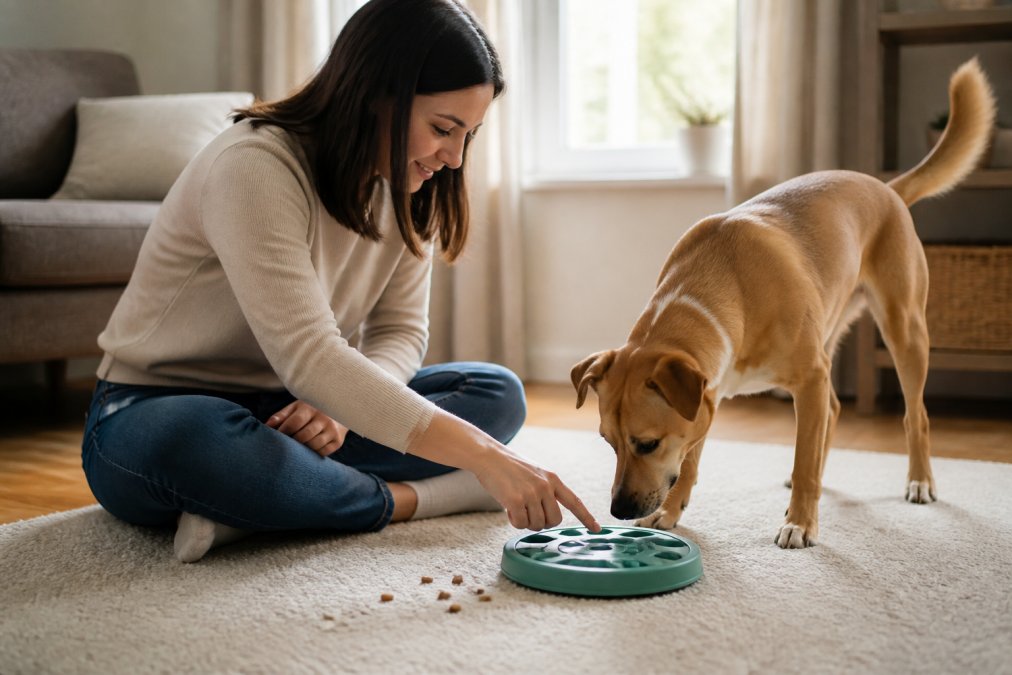
Before you start, set the room. Turn off the TV, put other pets behind a baby gate or in another room, and lay a non-slip mat under the toy so it does not skitter across hardwood. A sliding toy that shoots away from a dog's nose reads as a chase game, not a puzzle, and it can spike arousal in dogs that are already easily overstimulated.
Step 1: Build the Food-to-Object Association (Days 1-3)
Begin with the easiest possible version of the game. Place a few treats in a slow feeder or a basic dispenser with wide openings, then let your dog eat from it without any instruction. No shaping, no cues, just access.
Do this for two or three meals. Your dog learns that the object produces food, which is the foundation everything else builds on. During this phase, you are not training a behavior, you are building a positive conditioned emotional response to the object itself. If your dog backs away from the toy, scatter a few treats on the floor next to it and let the dog eat those. Do not push the toy toward the dog.
Step 2: Use Shaping, Luring, and Capture to Build the Behavior (Days 3-7)
Once your dog eats confidently from the simple version, you can shape more deliberate behavior. Shaping means rewarding successive approximations: first a glance toward the toy, then a sniff, then a nose touch, then a nudge, then a paw. Luring means guiding your dog's nose with a treat toward the mechanism, useful for the first two or three reps, then fade it fast so the dog is not waiting for your hand. Capture means marking and rewarding the moment your dog does the right thing on its own.
A practical session looks like this:
- Load the toy with three to five pea-sized treats. Any more and the dog gets full before the session ends.
- Place the toy on the mat and stand or sit one step back. Let the dog approach on its own.
- The moment the dog's nose touches the toy, mark with a calm "yes" and let the dog self-reward by eating what falls out. Do not add a treat from your hand on top of the food already in the toy, that double reward muddies the picture.
- If the dog does not engage within 30 seconds, reset by making the toy easier: loosen the opening, remove one compartment, or place a treat visibly on top of the mechanism.
- End the session after three to five successful reps, or after two minutes of clear engagement, whichever comes first.
Keep sessions short. Three to five repetitions with a reward after each is plenty for a beginner. Two short sessions a day beat one long one, because fatigue and frustration both build faster than most owners expect.
Step 3: Read Your Dog's Body Language Before You Add Difficulty
Before you raise the difficulty, learn what engagement and stress actually look like. Most beginner frustration problems come from owners misreading a stressed dog as a stubborn one.
Signs of engagement: loose, wiggly body; ears forward or neutral; tail at mid-height or wagging in a wide arc; nose staying on the toy; brief pauses to look at you and then back at the toy.
Signs of stress or shutdown: stiff body; ears pinned back; tail tucked or held low and still; lip licking when no food is present; yawning outside of nap time; turning the head away from the toy; freezing; or leaving the area entirely. A dog that walks away is not being defiant, it is telling you the task is past its current threshold.
If you see two or more stress signals in a row, stop the session and end on an easy win. Do not push through.
Step 4: Increase Difficulty Levels Gradually
Move up a difficulty level only when your dog solves the current one in under a minute, twice in a row. Increase one variable at a time: tighter openings, more compartments, a sliding mechanism instead of a rolling one, or a lid that requires lifting instead of nudging. Changing two variables at once is the fastest way to trigger frustration.
A simple progression that works for most beginners:
- Week 1: wide-opening slow feeder or rolling ball with large holes
- Week 2: same toy with one compartment blocked, or a snuffle mat
- Week 3: a two-step puzzle (lift a flap, then slide a tab)
- Week 4: a multi-compartment puzzle with one hidden compartment
If your dog regresses at any stage, drop back one level for two sessions before trying again. Regression is normal and is not a sign the dog has lost the skill.
Age-Specific Pacing Adjustments
Puppies under six months: cap sessions at three to five minutes, use larger and softer puzzle pieces, and expect to repeat Step 1 for a full week before moving on. Puppy attention spans reset quickly, and jaw strength is still developing, so avoid hard plastic mechanisms that require a strong paw.
Adult dogs: the four-week progression above is a reasonable default. Most adult dogs with no prior puzzle experience can move through Steps 1 and 2 within a week.
Senior dogs: keep the toy at floor level, avoid puzzles that require sustained pawing or standing, and shorten sessions to three to four minutes. Counterintuitively, many senior dogs solve puzzles faster than puppies because prior problem-solving experience transfers, adjust for mobility, not intelligence.
Managing Frustration: What to Do When Your Dog Gives Up
When a dog walks away from a puzzle, the correct response is to make it easier, not to encourage persistence. Frustration tolerance is built by stacking small wins, not by pushing through failure. But "make it easier" is only useful if you can tell the difference between the two kinds of quitting, and they need opposite responses.
Two Kinds of Quitting (and Why the Fix Is Different)
Type 1: Confusion quitting. The dog does not understand what the toy is asking. Signs: the dog sniffs the toy, paws at it randomly, looks at you, looks back at the toy, then disengages. The dog is not frustrated, it is missing information. The fix is to make the solution more obvious: place a treat visibly on top of the mechanism, loosen the opening, or remove a compartment so the dog can succeed on the next attempt.
Type 2: Frustration quitting. The dog understands the task but cannot complete it fast enough. Signs: whining, barking at the toy, pawing hard and repeatedly at the same spot, flipping the toy, or pushing it across the floor. The dog is over-aroused, not confused. The fix is to lower the difficulty one level and shorten the session, not to add more treats or more encouragement, which usually escalates arousal.
Treating a frustrated dog like a confused dog (adding hints) tends to make the behavior worse. Treating a confused dog like a frustrated dog (removing the toy) teaches the dog that quitting works.
A Concrete Reset Protocol
When your dog disengages, run this sequence in order:
- Pause for five seconds. Do not talk, do not touch the toy. Give the dog a chance to re-engage on its own.
- If the dog re-engages, stay quiet. Let it work. Only step in if it disengages a second time.
- If the dog does not re-engage, reduce difficulty by one variable. Loosen the opening, remove one compartment, or place a treat on top of the mechanism.
- Give the dog one more attempt. If it succeeds, mark and end the session on that win.
- If it fails again, end the session. Put the toy away. Do not leave it down.
A common mistake is leaving the toy down and hoping the dog figures it out later. That usually teaches the dog to ignore the toy entirely, and it can also create a resource-guarding or chewing problem if the dog redirects frustration onto the toy itself.
Frustration Thresholds by Experience Level
A dog that has never used a puzzle toy has a very short frustration window, often under 60 seconds. A dog with a few weeks of puzzle experience can typically sustain two to three minutes of active problem-solving before frustration builds. Do not assume your dog's threshold matches what you see online. Watch the body-language signals above and end sessions before the threshold is hit, not after.
When to Skip the Toy Entirely for the Day
Some days a dog is too tired, too distracted, or too aroused to work a puzzle productively. If your dog has had a high-energy event (a dog park visit, a grooming appointment, a house full of guests), skip the puzzle that day. A skipped session costs nothing. A bad session can set the introduction back a week.
Cleaning and Maintenance After Frustration Sessions
Frustrated dogs often drool heavily, paw at the toy with dirty feet, and leave saliva and treat residue in every compartment. After any session where the dog showed frustration signals, wash the toy the same day. Warm water, mild dish soap, and a bottle brush for narrow compartments. Rinse thoroughly, soap residue can make a dog refuse the toy on the next session. Air-dry completely before storing. A damp compartment grows bacteria within 24 to 48 hours, and a dog that gets a whiff of spoiled residue will often refuse the toy outright.
Choosing the Right Treats and Durable Toys for Aggressive Chewers
Treat selection matters as much as toy selection. Soft and chewy treats work best for beginners because they release quickly and keep motivation high. Hard biscuits slow the reward down, which is useful later but punishing at the start.
For dogs that destroy plush toys in minutes, durability is the deciding factor. Look for chew-resistant construction and materials that hold up to repeated biting. The American Kennel Club's guidance on safe chew toys notes that toy size and material should match your dog's chewing style, not just its breed size.
Durable toys for aggressive chewers should be inspected weekly for cracks or loose pieces. Even the toughest toy eventually wears down.
How to Keep Dogs Busy: Rotation, DIY Puzzles, and Daily Routines
The most effective way to keep dogs busy is rotation. A puzzle that stays on the floor loses novelty within days, and novelty is what drives engagement. Keep three or four puzzles in circulation and swap them every few days.
Pair puzzles with a daily routine: one puzzle in the morning before you leave, one in the evening after dinner. Predictable timing reduces anxiety and turns enrichment into part of the day rather than a special event.
DIY Puzzle Toy Alternatives You Can Build Today
You do not need to buy anything to start. A muffin tin with treats under tennis balls makes a simple scent-driven puzzle. A cardboard box with treats folded into paper creates a shredding puzzle for supervised play. A towel rolled with kibble inside gives a low-cost sniffing challenge.
These DIY options are excellent for testing whether your dog enjoys puzzle work before you invest in durable toys.
Supervision, Safety, and Cleaning Your Puzzle Toys
Puzzle toys should be used under supervision until you know how your dog interacts with them. Some dogs chew plastic components; others try to swallow fabric. Neither is safe unattended.
Frequently Asked Questions
How often should I give my dog a puzzle toy?
Start with one short session per day, about 5 to 10 minutes, and work up to two or three sessions as your dog gains confidence. Puzzle toys for dogs work best as part of a routine rather than an all-day free-for-all. Rotating three to five different puzzles through the week keeps novelty high and prevents your dog from memorizing the solution and losing interest. If your dog walks away after two minutes, that is a sign the difficulty is too high, not that the toy is boring.
What should I do if my dog gets frustrated with a puzzle toy?
Drop the difficulty immediately. Remove one obstacle, loosen a compartment, or switch to a slow feeder where food is visible. Pair the easier version with positive reinforcement, praising and treating the moment your dog sniffs, paws, or nudges the toy. End the session on a win within 60 seconds. Frustration tolerance builds through repeated small successes, not through forcing a dog to push past a wall. If your dog shuts down twice in a row, set that puzzle aside for a week.
Are puzzle toys safe for aggressive chewers?
Not all of them. Soft plastic and thin-walled puzzles crack under heavy jaw pressure and can create sharp edges. Look for chew-resistant options made from durable rubber or reinforced canvas, and check the toy's size against your dog's mouth so nothing can be swallowed. Supervised play is essential for strong chewers, especially in the first few sessions. A canvas chew toy like the Bite-Resistant Cartoon Pet Dog Toy at $14.98 gives a heavy chewer something to work on while you decide which puzzle suits them.
How do I choose the right difficulty level for a beginner dog?
Pick a puzzle your dog can solve in under 30 seconds on the first try. That usually means a slow feeder, a snuffle mat, or a single-compartment treat dispenser where the food is partly visible. Once your dog finishes consistently without help, move up one level, such as a sliding-block puzzle or a toy with two or three hidden compartments. Most dogs need one to two weeks at each level. Skipping ahead is the single most common reason beginners quit.
Puzzle toys only work if your dog actually enjoys them, and that depends on starting easy, rotating often, and stopping before frustration sets in. My Store carries durable, pet-safe toys built for exactly this kind of daily enrichment, along with easy-to-clean materials and a 30-day return policy if something does not fit your dog's play style. Get started with My Store and turn mealtime into the most engaging part of your dog's day.