

Why Your Dog Needs an Orthopedic Bed: A 2026 Guide
Table of Contents
- What an Orthopedic Bed Actually Does for Your Dog
- Signs of Joint Pain in Dogs You Should Not Ignore
- Orthopedic vs Regular Dog Beds: What Is the Real Difference?
- How Orthopedic Beds Help with Arthritis and Hip Dysplasia
- Durable Dog Beds for Chewers: What to Look For
- When to Start Using an Orthopedic Bed
- Maintaining Your Orthopedic Bed for Long-Term Support
- Frequently Asked Questions
Last Updated: September 20, 2026
What an Orthopedic Bed Actually Does for Your Dog
An orthopedic bed is a sleep surface engineered to distribute a dog's weight evenly and reduce pressure on joints, hips, and the spine. This guide from My Store explains why that matters more than most owners realize until their dog starts slowing down.
Here's the uncomfortable truth: dogs hide pain. By the time you notice your dog hesitating on the stairs or struggling to rise, joint discomfort has often been developing for months. A supportive bed is one of the few interventions you can make today that pays off every single night.
Below, we'll cover the signs of joint pain in dogs, how orthopedic beds differ from regular ones, which breeds face the highest risk, and how to maintain a bed so it keeps working long after the new-bed smell fades.
Memory Foam and High-Density Support Explained
Memory foam responds to body heat and pressure, molding to a dog's shape rather than forcing the body to conform to a flat surface. High-density foam does the structural work underneath, keeping the bed from collapsing under a large breed's weight.
Cheap beds use low-density fill that flattens within weeks. Once it compresses, the support is gone, and your dog is essentially sleeping on the floor with extra steps. Look for beds described as orthopedic grade with a foam base that springs back when pressed.
Signs of Joint Pain in Dogs You Should Not Ignore
The clearest signs of joint pain in dogs are reluctance to climb stairs, stiffness after rest, and a shift in sleeping posture. Dogs in discomfort often circle more before lying down or avoid jumping onto furniture they used to clear easily.
Watch for these specific behaviors:
- Slower to rise after naps, especially in the morning
- Lagging behind on walks that used to be easy
- Licking or chewing at a specific joint
- Irritability when touched near the hips or shoulders
- Preferring hard floors over a previously favorite soft spot
That last one trips people up. A dog avoiding its own bed is often a dog whose bed has stopped providing relief.
Orthopedic vs Regular Dog Beds: What Is the Real Difference?
The difference between orthopedic and regular dog beds comes down to foam density, thickness, and how the surface handles weight distribution. A regular bed is a comfort product. An orthopedic bed is a support product that happens to be comfortable.
| Feature | Regular Dog Bed | Orthopedic Dog Bed |
|---|---|---|
| Fill material | Polyester fiber, low-density foam | Memory foam, high-density foam |
| Weight support | Compresses under large dogs | Holds shape under body weight |
| Joint pressure relief | Minimal | Designed to reduce pressure points |
| Lifespan | Months before flattening | Years with proper care |
| Best for | Young, healthy dogs | Seniors, large breeds, joint issues |
For a young, healthy small dog, a regular bed is fine. For a senior Labrador or a dog with hip dysplasia, the difference is not cosmetic. It is the difference between support and a slow slide toward the floor.

How Orthopedic Beds Help with Arthritis and Hip Dysplasia
Orthopedic beds help arthritis and hip dysplasia by keeping the spine aligned and cushioning the joints that bear the most weight. When a dog sinks into a soft, unsupportive surface, the hips and shoulders settle into unnatural angles that aggravate inflammation overnight.
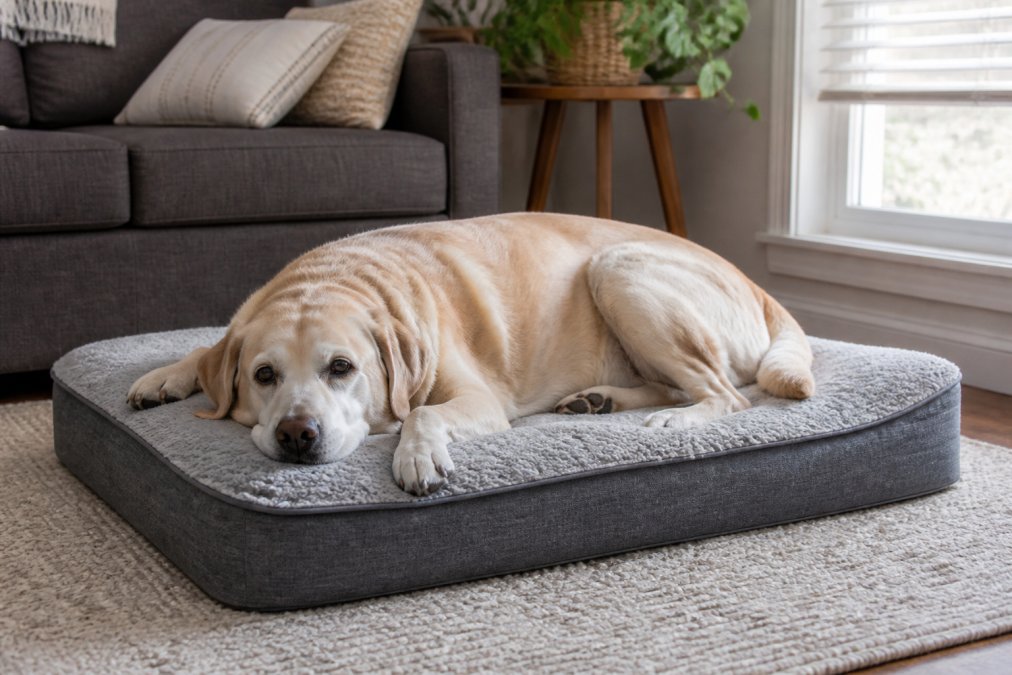
The right bed keeps the body level. That reduces the pressure points that flare up during long stretches of sleep, when a dog isn't shifting position to relieve discomfort.
The Mechanism: Why Compression Matters More Than Softness
Joint pain in dogs with arthritis and hip dysplasia is driven largely by two forces: sustained pressure on a joint in one position, and the micro-movement that happens when a dog's body sinks and then has to re-stabilize. A soft bed feels luxurious but lets the hips drop below the level of the spine, which loads the hip joint at an angle it wasn't built to hold for eight hours.
A high-density foam base resists that drop. The foam compresses just enough to contour to the body, then stops, so the hip stays roughly level with the spine and the shoulder stays supported rather than rolled forward. That's the difference between a surface that holds a dog and one that swallows them.
This is also why thickness alone isn't the answer. A four-inch bed of low-density fill will bottom out under a 90-pound dog within weeks. A three-inch bed of genuinely high-density foam can outperform it for years. Density, not depth, is the variable that matters.
Breed-Based Risk Profiles: Who Needs Support Earlier
Most guides say 'large breeds' and stop there. The more useful question is which dogs should transition to orthopedic support before symptoms appear, because joint disease in these breeds is often genetic rather than purely age-related.
- German Shepherds, Labrador Retrievers, Golden Retrievers, and Bernese Mountain Dogs carry well-documented predisposition to hip dysplasia. Many practitioners suggest introducing orthopedic support in the first two to three years, not waiting for middle age.
- Rottweilers, Great Danes, and Saint Bernards combine heavy body weight with fast growth, which puts extra load on developing joints. Early support is reasonable here too.
- Dachshunds, Corgis, and Basset Hounds have long spines relative to their leg length, which shifts the risk toward intervertebral disc issues rather than hips. A firmer, flatter orthopedic surface that supports the length of the spine is more useful than a deep, nest-style bed that lets the back curve.
- Bulldogs, Pugs, and other flat-faced breeds often have abnormal joint conformation alongside their airway issues, and they tend to overheat. A breathable orthopedic cover matters as much as the foam for these dogs.
For a mixed breed, look at body shape rather than label: a dog with a long back, a heavy chest, or a history of limping after rest is a candidate regardless of size.
Relief for Stiffness and Joint Inflammation
Stiffness after rest is the symptom owners notice first. A supportive surface limits the compression that leaves joints locked in awkward positions, which is why many owners report their dog moves more easily in the morning after switching beds.
Elevated Rectangle Dog Sofa Bed →
Combined with ramps and stairs to reduce jumping, an orthopedic bed becomes part of a broader joint management routine. You can pair a supportive bed with a Dog Stair Ramp with Bone Handle so your dog reaches the couch or bed without the jarring landing that aggravates sore hips.

The Floor Under the Bed Matters Too
This is the part almost every guide skips: the surface your dog walks on between naps affects how much the bed can help. A dog with hip dysplasia navigating smooth tile has to grip and stabilize with every step, which fatigues the same muscles that need to relax during sleep. Placing the bed on carpet, a rug, or a non-slip mat, and adding runners along the dog's main path, reduces that daily strain. If the bed sits on hardwood or tile, check that it has a non-slip bottom; a bed that slides when your dog steps on it defeats the purpose.
Durable Dog Beds for Chewers: What to Look For
Durable dog beds for chewers need reinforced stitching, tough cover fabric, and a foam core that doesn't shred into ingestible chunks. The failure point is almost never the foam. It's the seams.
What holds up in practice:
- Double-stitched or bound edges rather than single seams
- Covers that zip closed with the zipper tucked into a fabric flap
- Removable, machine-washable covers so you can clean without replacing
- Foam cores that stay intact even if the cover is damaged
For dogs who destroy everything, consider an elevated design that lifts the sleeping surface off the floor. The Elevated Rectangle Dog Sofa Bed uses a raised frame with thick padding and removable, machine-washable fabric, which keeps the foam core protected from a determined chewer.

When to Start Using an Orthopedic Bed
Start using an orthopedic bed before your dog shows symptoms, not after. Preventative care is far cheaper than managing chronic joint pain, and large breeds benefit most from early support.
Breed matters here. Dogs with a genetic predisposition to hip dysplasia, including German Shepherds, Labradors, Golden Retrievers, and Bernese Mountain Dogs, face elevated risk from a young age. Small breeds with long backs, like Dachshunds, benefit from spinal support early too.
A reasonable rule: switch large and giant breeds to orthopedic support by middle age, and start any dog with a known joint condition immediately. The Square Plush Dog Bed works well as a soft secondary spot for smaller or younger pets, while a firmer orthopedic surface handles the primary sleeping position.
Maintaining Your Orthopedic Bed for Long-Term Support
Maintaining an orthopedic bed means protecting the foam core, not just washing the cover. Most owners clean the outside and never check whether the inside still works, which is exactly why so many 'orthopedic' beds stop being orthopedic long before they're thrown out.
Cleaning High-Density Foam Without Ruining It
The foam core is the expensive part, and it's the part most cleaning advice gets wrong. High-density foam is an open-cell structure: it holds its shape because air moves through those cells and springs back. Soak it, and water fills the cells, the foam stays heavy and damp for days, and mold and bacteria take hold inside where you can't see them. The cell walls also weaken when repeatedly saturated, which is why a soaked foam core often feels softer and flatter after it dries.
What actually works:
- Covers: Wash every two to four weeks with a pet-safe, enzyme-based detergent in cold or warm water. Skip fabric softener, it coats the fibers and traps odor.
- Foam core: Vacuum both sides monthly with an upholstery attachment to pull out dander, hair, and dust mites. For accidents or spills, blot immediately with a clean cloth, then spot-clean with a damp cloth and a mild enzyme cleaner. Never submerge the foam.
- Drying: If the foam does get damp, lay it flat in a well-ventilated area out of direct sun and let it air-dry completely before putting the cover back on. Sun breaks down both foam and cover fabric.
- Rotation: If the bed is reversible, flip and rotate it every few weeks so wear is distributed rather than concentrated where your dog always lies.
Signs Your Bed Has Lost Its Orthopedic Value
A bed can look fine and still be doing nothing. The cover hides the problem, so you have to test the foam directly.
- The press test: Press your palm firmly into the center and hold for ten seconds. Release. The foam should spring back to its original height within a few seconds. If it stays compressed, or recovers slowly, the support is gone.
- The dip test: Run your hand across the sleeping surface. A visible or felt dip where your dog always lies means the foam has taken a permanent set.
- The edge test: Crunchy or crumbly foam at the edges means the cell structure is breaking down. That debris can also become a choking or blockage risk if the cover tears.
- The behavior test: A dog who suddenly prefers the floor, circles more before lying down, or is slower to rise in the morning may be telling you the bed stopped working, not that they've stopped wanting a bed.
Any one of these is a replacement signal. Compressed foam offers no joint support regardless of how good the cover looks.
Environmental Factors That Shorten Bed Life
Where the bed sits affects how long it lasts. Beds placed near heating vents dry out and crack. Beds in damp basements or on concrete floors pull moisture into the foam. Beds in direct sun fade and weaken the cover fabric. Keep the sleeping spot dry, ventilated, and out of harsh light, and lift the bed off bare concrete if you can.
A Simple Maintenance Schedule
- Wash the cover every two to four weeks with pet-safe detergent
- Vacuum the foam core monthly to remove dander and dust mites
- Press-test the foam every three months for compression and recovery
- Rotate or flip the bed every few weeks if the design allows
- Replace the bed once the foam stays compressed after pressure
Frequently Asked Questions
Do dogs really need orthopedic beds?
Not every dog needs one, but many benefit. Dogs with arthritis, hip dysplasia, or post-surgical recovery see real relief from pressure point support. Senior dogs and large breeds are prime candidates because their joints carry more weight and show age-related decline sooner. Even young, active dogs can benefit as preventative care. If your dog shows stiffness after sleeping or avoids certain surfaces, an orthopedic bed is worth trying.
At what age should a dog start using an orthopedic bed?
Most vets suggest starting around age 6 to 7 for large breeds and 8 to 10 for smaller dogs. Large breeds age faster and put more stress on joints, so earlier support helps. If your dog has a known condition like hip dysplasia, start immediately. Preventative care with a supportive bed can slow joint inflammation and keep your dog comfortable longer.
What are the downsides of using an orthopedic bed?
The main downsides are cost and maintenance. High-density foam beds cost more upfront, and the foam can trap odors or moisture if not cleaned properly. Some dogs chew the foam, especially puppies. You also need to replace the bed when it loses firmness. Weigh these against the joint health benefits for dogs with mobility issues.
How do I know if my dog is in pain while sleeping?
Watch for restlessness, shifting positions frequently, whining, or waking up stiff. Dogs in pain may avoid lying down fully or sleep in odd positions to relieve pressure points. They might also hesitate to jump onto furniture or show reduced mobility after naps. If you notice these signs of joint pain in dogs, an orthopedic bed with memory foam can provide pressure-relieving support and improve sleep quality.