

Durable Orthopedic Beds for Large Dogs: 2026 Picks
Table of Contents
- Why Large Dogs Need Orthopedic Support
- Quick Comparison: Top Durable Orthopedic Beds for Large Dogs
- Orthopedic Dog Bed for Chewers: What Holds Up
- How to Choose the Right Size Dog Bed
- Dog Bed Maintenance Tips for Long-Lasting Support
- Bed Placement and Home Ergonomics
- Frequently Asked Questions
Last Updated: September 13, 2026
Why Large Dogs Need Orthopedic Support
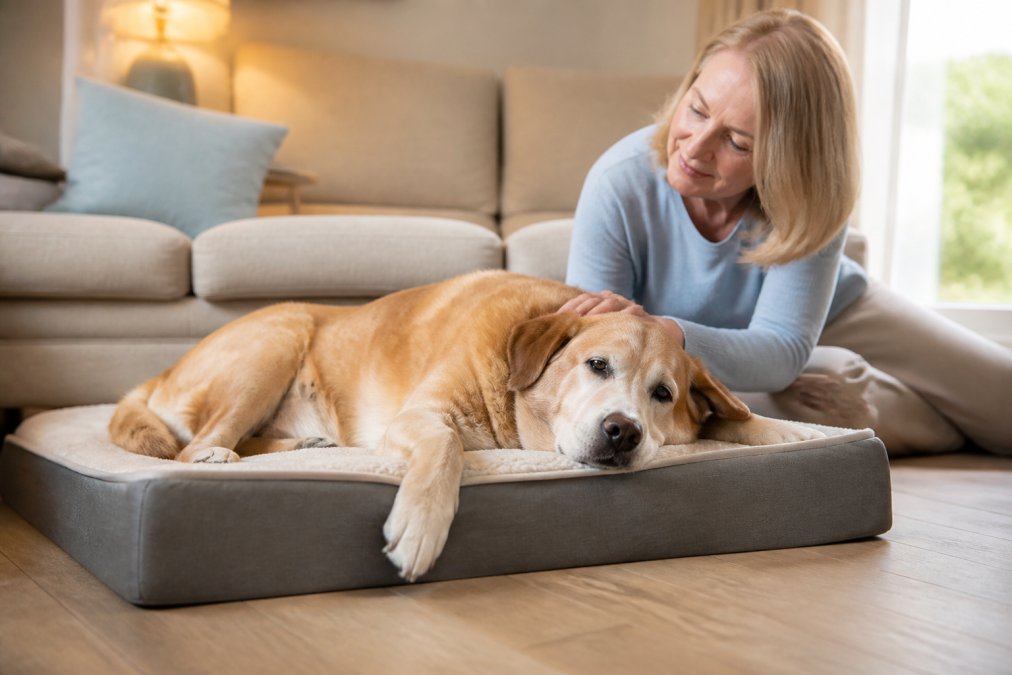
A dog carrying 90 pounds through a decade of stairs, tile floors, and couch launches puts serious load on hips and elbows. A seven-year-old Labrador who used to sprint the hallway now hesitates at the top step (avma.org). That hesitation is usually joint discomfort, not stubbornness.
Durable orthopedic beds for large dogs are built to absorb that load instead of bouncing it back into the joints. Standard poly-fill cushions compress within months under a big dog's weight and stop supporting anything. High-density foam holds its shape, spreads weight across the whole body, and keeps pressure points off the elbows and hips.
The practical payoff is measurable in daily behavior: easier standing, less circling before lying down, and longer stretches of uninterrupted sleep. For dogs managing arthritis or recovering from surgery, the bed is not a luxury purchase. It is part of the treatment plan.
Quick Comparison: Top Durable Orthopedic Beds for Large Dogs
Three beds cover almost every large-breed household, and they solve different problems.
| Product | Price | Best For | Key Feature |
|---|---|---|---|
| Elevated Rectangle Dog Sofa Bed | $314.16 | Everyday joint support | Raised frame, removable washable cover |
| Giant Human-Size Dog Bed | $175.20 | Multi-pet households | Oversized surface for dogs and humans |
| Thickened Non-Slip Pet Bed Mat | $32.52 | Budget top-up or travel | Water-resistant plush, non-slip base |
Elevated Rectangle Dog Sofa Bed - Durable Couch for Medium & Large Dogs
This is the pick for most large-breed owners because it solves the two problems that kill cheap beds: compression and access. The elevated frame lifts your dog off cold floors, and the foam padding is thick enough that a 90-pound dog does not bottom out overnight. The Elevated Rectangle Dog Sofa Bed's dimensions are 40.50 inches in length, 23.50 inches in width, and 15.00 inches in height. This suits most medium and large breeds without eating an entire room.

The cover removes for machine washing, and the stitching holds up to daily use. One honest note: at $314.16 it costs more than a big-box cushion.
Giant Human-Size Dog Bed - Portable Pet Bed for Adults & Pets
Picture two Great Danes and a teenager fighting over the same spot. This bed is oversized on purpose, so it works as a shared surface rather than a single-dog pad. At $175.20 it undercuts the sofa bed while offering more square footage.
The trade-off is structure. You get size and portability, not the raised frame and firm support of the sofa bed. For a dog with real hip dysplasia, the firmer option wins. For a household that wants one big, washable, movable surface, this is the smarter buy.
Thickened Non-Slip Pet Bed Mat - Winter Warm Dog & Cat Pad
Not every purchase needs to be the main bed. This mat costs $32.52 and does a specific job well: it adds a warm, water-resistant layer on top of an existing bed, a crate floor, or a car seat. The non-slip base keeps it from sliding across hardwood when your dog launches off it.
Where it falls short is depth. This is a mat, not a mattress, so it will not replace a high-density foam base for a dog with serious joint pain. Buy it as a supplement, not a solution.
Orthopedic Dog Bed for Chewers: What Holds Up
An orthopedic dog bed for chewers lives or dies on materials and construction, not marketing copy. Most beds fail at the seams and zippers long before the foam gives out, so inspect the cover the way you would inspect a work boot: fabric weave, thread count at the stress points, and how the closure is protected.

Chew-Resistant Materials That Last
Fabric weave matters more than thickness. A tightly woven fabric resists a dog's incisors far better than a loose-knit plush or a thin microfiber, because the yarns are packed so tightly there is no gap for a tooth to catch. Loose knits and open-weave canvas unravel one thread at a time, which is exactly the failure mode a determined chewer exploits.
Look for these construction cues on the label or product page:
- Binding tape: heavy-duty binding along every perimeter seam, not just the top edge.
- Reinforced corners: the four corners take the most mouthing; double-layer or bar-tacked corners last measurably longer.
- Recessed zipper channel: a zipper tucked under a fabric flap is far harder to reach than an exposed one.
Reinforced Stitching and Zipper Guards
Double-stitched seams with a lockstitch or a box-X pattern at the corners distribute pulling force across more thread than a single stitch line. A common mistake is buying a great foam base with a flimsy cover, then replacing the whole bed when the cover shreds. If your dog is a dedicated chewer, budget for a replacement cover up front or choose a bed with a recessed zipper channel and a cover sold separately.
Non-Toxic and Low-Emission Materials
A bed your dog sleeps on eight hours a night is a long-exposure product, so material safety deserves the same scrutiny as chew resistance. Foam and fabric can off-gas volatile organic compounds (VOCs), and some older polyurethane foams and stain-resistant finishes have historically contained flame retardants or per- and polyfluoroalkyl substances (PFAS) (the EPA).
What to look for:
How to Choose the Right Size Dog Bed
Measure your dog lying flat, nose to tail, then add roughly 8 to 10 inches of slack. A bed that fits a curled-up sleeper will not fit the same dog stretched out, and large breeds sprawl.
Measure Your Dog, Not Just the Bed
Use a tape measure while your dog is fully extended on the floor. Record length and width, then compare against the bed's interior dimensions, not the outer frame. The Elevated Rectangle Dog Sofa Bed's surface fits most large breeds comfortably; giant breeds and multi-dog sleepers need the oversized Giant Human-Size Dog Bed instead.
Weight-Specific Support Chart
Match support level to body weight, not breed name.
- Under 50 lbs: standard thick foam works fine
- 50 to 80 lbs: high-density foam, minimum 3 inches thick
- 80 to 120 lbs: high-density foam, 4 inches or more, firm base
- Over 120 lbs: firmest available foam plus a supportive base, or an elevated frame
Dog Bed Maintenance Tips for Long-Lasting Support
A quality bed lasts years if you maintain the foam and the cover as two separate systems. The foam does the orthopedic work; the cover protects the foam. When the cover fails, the foam is exposed to moisture, odor, and compression damage that no amount of washing can reverse.
Cover Care
Wash covers every two to four weeks, and spot-clean accidents immediately so moisture never reaches the foam core. Most removable covers are machine washable on cold and should be air-dried or tumble-dried on low, high heat shrinks the fabric and can warp a waterproof backing. Zip the cover closed before washing so the zipper does not snag the drum or tear the fabric.
Check the cover monthly for thin spots, pulled seams, and a zipper that no longer closes flush. A cover with a failing zipper is a cover about to expose the foam.
Foam Care
Foam itself should never go in a washing machine. Water breaks down the cell structure of polyurethane foam, and a soaked core can take days to dry, during which mold and mildew can establish (the CDC). Instead:
- Vacuum the surface with a brush attachment to lift hair and dander.
- Air the foam outdoors in shade for a few hours monthly to release trapped moisture and odor.
- Rotate the bed head-to-foot every few weeks so weight distribution stays even and one end does not compress permanently.
- Blot, never soak, any liquid that reaches the foam, then air-dry fully before the cover goes back on.
Why Foam Density Determines Lifespan
Foam is rated in density (pounds per cubic foot) and in ILD (Indentation Load Deflection), which measures firmness. A high-density foam holds its shape under a large dog's weight; a low-density foam compresses permanently within months. As a rough guide, most large-breed orthopedic beds use foam in the 3 to 5 lb/ft³ range, and a 100-pound dog needs at least 4 inches of thickness so its hips never reach the floor.
When foam loses its rebound, you press it and it stays dented, the orthopedic benefit is gone even if the cover looks fine. That is the signal to replace the foam, not the whole bed.
The Cover-Replacement Math
A replacement cover typically costs a fraction of a new bed, and swapping it early is the single cheapest way to extend the expensive part's life. Keep one spare cover on hand if your dog is a chewer or a heavy shedder, so a torn cover never leaves the foam unprotected while you wait for a replacement to ship.
For waterproof protection, a water-resistant cover or an inexpensive mat layer on top does more for longevity than any cleaning product.
Bed Placement and Home Ergonomics
Where the bed sits matters as much as what the bed is made of. Dogs with joint pain struggle on slick hardwood and tile, so place the bed on carpet, a rug, or a non-slip mat. The non-slip bottom on the Thickened Non-Slip Pet Bed Mat solves this directly for lighter setups.

Avoid drafty spots near doors and air vents. Cold air stiffens sore joints overnight, and a warm, draft-free corner supports better sleep. For dogs who sleep on the couch or your bed, a ramp or set of stairs removes the jump that does the most damage to hips. Our Dog Stair Ramp with Bone Handle uses high-density soft foam and a low-angle slope for joint safety, with a non-slip base and a waterproof & washable cover, tested for pets up to 50 lbs.
One more placement rule: keep the bed in a low-traffic corner. Startled dogs tense up when they stand, and a quiet spot lets them rise slowly and safely.
Frequently Asked Questions
What is the best orthopedic dog bed for large dogs?
The best choice depends on your dog's weight and sleeping style. For large dogs needing pressure point relief and joint pain relief, look for high-density foam at least 4 inches thick with a removable, machine-washable cover. The Elevated Rectangle Dog Sofa Bed offers a supportive base with a non-slip bottom and fits dogs up to 40 by 23 inches. For giant breeds, the Giant Human-Size Dog Bed provides extra room and a plush surface that distributes weight evenly.
What kind of dog bed is best for a large dog with arthritis?
A firm orthopedic bed with memory foam or high-density foam is best for arthritis management. The foam should be thick enough to keep hips and elbows off the floor, reducing pressure on sore joints. Look for a bed with a low entry point so your dog can step in without jumping. The Elevated Rectangle Dog Sofa Bed has a supportive base.
Are orthopedic beds better for dogs?
Orthopedic beds are better for dogs that need joint support, especially large breeds prone to hip dysplasia or post-surgery recovery. The dense foam in these beds distributes weight across pressure points, which can ease discomfort and improve sleep quality. For healthy young dogs, a standard bed may be enough. But for seniors or dogs with mobility issues, an orthopedic bed is worth the investment.
How do I know if my dog needs an orthopedic bed?
Signs include stiffness after naps, difficulty getting up, reluctance to jump on furniture, or visible discomfort when lying down. Large breeds and seniors are prime candidates. If your dog has been diagnosed with arthritis or hip dysplasia, an orthopedic bed is a practical addition. Even as a preventive measure, high-density foam supports joint health over time. Watch how your dog settles and whether they shift frequently to get comfortable.
How do I keep an orthopedic bed clean and durable?
Use a removable cover and wash it every two to four weeks with pet-safe detergent. Vacuum the foam core monthly to remove dander and dust. For chewers, choose a bed with tear-resistant fabric and reinforced stitching. Rotate the bed occasionally to prevent uneven wear. The Thickened Non-Slip Pet Bed Mat has a waterproof layer and is machine washable, making it easy to maintain without degrading the support.
Large breeds with joint issues deserve better than a compressed cushion that quits in six months. My Store builds pet essentials around durable, pet-safe materials, mess-free cleaning, and everyday toughness, backed by 24/7 customer support, 100% secure checkout, and easy 30-day returns. If your dog needs real orthopedic support, start with the Elevated Rectangle Dog Sofa Bed and give those hips the firm, lasting base they have been missing.