

How Long Do Indestructible Dog Toys Really Last?
Table of Contents
- Why "Indestructible" Is a Marketing Term, Not a Promise
- What Actually Determines How Long a Tough Toy Lasts
- Best Materials for Heavy Chewers: What Holds Up and What Doesn't
- Durable Toys for Aggressive Chewers: Matching the Toy to the Dog
- Signs a Dog Toy Is Unsafe: When to Replace It Immediately
- Material Toxicity and Ingestion Risks Most Owners Miss
- Repair, Rotation, and Maintenance: Making Toys Last Longer
- Behavioral Root Causes: Why Some Dogs Destroy Everything
- Frequently Asked Questions
Last Updated: September 14, 2026
Why "Indestructible" Is a Marketing Term, Not a Promise
Walk down any pet aisle and you'll see the same word plastered across packaging: indestructible. It sells. It also sets an expectation no toy can fully meet. This guide from My Store cuts through the claims and gives you a realistic picture of how long do indestructible dog toys really last.
The honest answer? Most so-called indestructible dog toys last anywhere from a few days to several months, depending on your dog's jaw strength, play style, and how the toy is used. There is no toy that survives every dog forever. The term is a marketing shortcut, not a guarantee, and the American Kennel Club's guidance on safe dog chews makes clear that even the toughest products wear down over time.
That matters because a worn toy can become a choking hazard or cause intestinal blockages. Below, we'll show you exactly what determines a toy's real lifespan, how to spot danger signs early, and how to match durable toys for aggressive chewers to the dog in front of you.
What Actually Determines How Long a Tough Toy Lasts
Three factors decide whether a tough toy survives a week or a season: jaw strength, play style, and material quality. Get these wrong and even the best-made toy fails fast.
Jaw Strength and Chew Intensity
A dog's bite force varies enormously by breed and size. A Chihuahua and a Mastiff are not working against the same forces. Chew intensity, sometimes called chew drive, measures how hard and how persistently a dog works a toy. High-intensity chewers apply concentrated pressure at the same spot repeatedly, which is what causes punctures and tears.
Play Style: Chewing, Shredding, or Fetching
How your dog plays matters as much as how hard it bites. Chewers gnaw; shredders pick at seams and edges until they find weakness; fetchers and tuggers stress the toy at joints. A toy built for chewing may fail quickly under a dedicated shredder. Match the toy to the behavior, not just the breed.
| Factor | Low Impact | High Impact |
|---|---|---|
| Jaw strength | Small breeds | Large breeds |
| Play style | Gentle fetching | Persistent shredding |
| Session length | Short bursts | Long, daily sessions |
Best Materials for Heavy Chewers: What Holds Up and What Doesn't
Natural rubber and dense nylon hold up best for heavy chewers, while thin plastics and plush fabrics fail quickly. But "holds up best" is not the same as "safe indefinitely," and the difference between a material that flexes and one that fractures is the single most useful thing to understand before you buy.
The Two Failure Modes: Flex vs. Fracture
Every chew toy fails in one of two ways. It either flexes, bending, compressing, and springing back until it eventually tears at a stress point, or it fractures, staying rigid until it cracks, splinters, or shears off a chunk. Flex failures tend to produce large, visible tears you can catch on inspection. Fracture failures are the dangerous ones, because a hard toy can shed a sharp shard with no warning and no obvious wear pattern.
That is why the hardest toy is rarely the safest toy. A material that is too rigid for your dog's bite force converts chewing energy into fracture instead of deformation.
How the Common Materials Actually Behave
- Natural rubber: Flexes under load and rebounds, so it fails gradually rather than suddenly. Best all-around choice for most power chewers. Watch for the point where a chewed edge stops springing back, that is the transition from flex to tear.
- Dense nylon: Extremely hard and long-wearing, but it is a fracture material. It can crack under sustained concentrated pressure, and worn nylon develops rough, abrasive edges that can scrape gums and wear enamel. Size it generously and retire it at the first sign of roughness.
- Reinforced fabric and canvas: Good for tug and fetch, where the load is spread across seams. Shredders defeat it by working a single seam until the weave separates. Canvas with double-stitched or bound edges resists this longer than single-stitch construction.
- Thin plastic and plush: Avoid for aggressive chewers. Thin plastic fractures into sharp fragments; plush is designed to be de-stuffed and offers no durability at all.
What the Label Doesn't Tell You
Marketing terms like "tough," "ultra-durable," and "indestructible" are not standardized, so they carry no measurable meaning. What you can actually evaluate is construction: wall thickness, whether seams are stitched or bonded, whether the material returns to shape after you compress it, and whether the toy is rated for the size and chew intensity of your dog. A thick-walled natural rubber toy with molded (not glued) seams will outlast a thin, hard toy with the boldest claim on the package every time.
Match the Material to the Behavior
A chewer and a shredder need different materials. Chewers apply steady compression and do best with flex materials like natural rubber. Shredders apply tearing force at edges and seams, so they need either a material with no separable layers or a toy you are willing to treat as disposable. Fetchers and tuggers stress joints and handles, so reinforced fabric with bound edges is the better fit. Buying for the behavior, not the breed, is what actually extends lifespan.
The ASPCA's pet toy safety guidance recommends checking material integrity regularly, since even tough materials degrade with use.
Durable Toys for Aggressive Chewers: Matching the Toy to the Dog
The right toy is the one sized and rated for your specific dog, not the one with the boldest claim. A toy that's too small invites choking; one that's too hard can crack teeth.
Size, Weight, and Age Matter More Than You Think
Choose a toy large enough that your dog can't swallow it whole, and firm enough to resist but not so hard it damages enamel. Puppies in the teething stage need softer, flexible materials for sore gums. Senior dogs with worn teeth do better with gentler textures. Age-specific durability is one of the most overlooked factors in toy selection.
Signs a Dog Toy Is Unsafe: When to Replace It Immediately
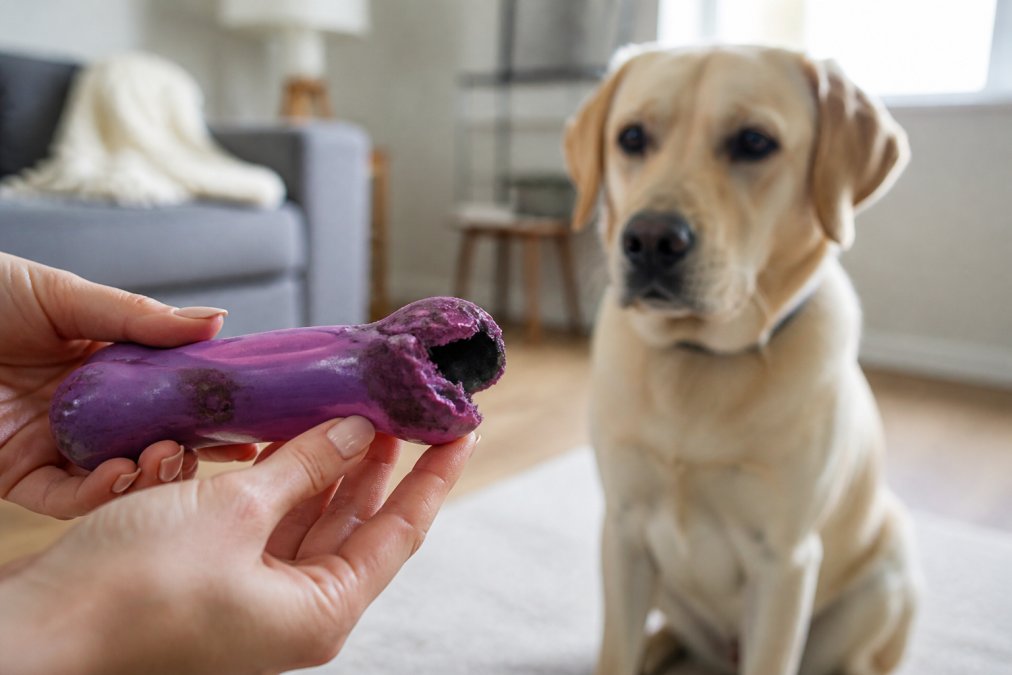
Replace a dog toy the moment you see cracks, exposed seams, missing chunks, or pieces small enough to swallow. That is the short answer, and every guide gives it. What most guides skip is why each sign matters and what actually happens after a fragment goes down, which is the part that should drive how seriously you treat a worn toy.

What Each Warning Sign Actually Means
- Cracks and splits: The material has moved from flexing to fracturing. A crack is a fracture line waiting to propagate, and the next hard bite can release a shard.
- Exposed or frayed seams: The structural joint has failed. Once a seam opens, the toy can be deconstructed from the inside, and stuffing or squeakers become accessible.
- Missing chunks or a shrinking toy: Material has already been swallowed. This is not a wear indicator, it is an active ingestion event, and the missing piece is somewhere in your dog.
- Sharp edges after chewing: Worn nylon and hard plastic develop abrasive ridges that can cut gums, tongue, and the soft tissue of the mouth.
- A piece small enough to swallow: Size is the threshold that turns a worn toy into a medical risk. Anything that fits fully behind the teeth can be swallowed whole.
Why Ingestion Is the Real Danger
A swallowed fragment does not simply pass or not pass. It can lodge in the esophagus, stomach, or intestine and create an obstruction. Symptoms often lag the event by hours or days, vomiting, loss of appetite, lethargy, abdominal pain, or straining to defecate, which means by the time you notice, the fragment may already be causing tissue damage. Hard, angular fragments from fractured nylon or plastic are the highest concern because they can both block and perforate.
This is also where material quality compounds the risk. A toy made from cheap or unlabeled plastics can shed fragments that carry the same chemical concerns as the base material, so a worn cheap toy is a durability problem and a toxicity problem at once. The FDA's information on pet food and product safety is a useful starting point for understanding what is regulated and what is not.
The Weekly Inspection Routine
Run this check every week, and after every long chew session:
- Any cracks, splits, or punctures?
- Loose or frayed seams?
- Missing pieces or a shrinking toy?
- Sharp edges after chewing?
- A piece small enough to swallow?
If you check any box, retire the toy. A replacement cycle based on inspection beats a calendar every time, because two dogs of the same size can destroy the same toy weeks apart.
Set a Hard Ceiling, Not Just a Checklist
Inspection catches gradual wear, but it can miss the toy that looks fine and fails suddenly. For hard materials, set a maximum service life regardless of appearance, dense nylon and hard plastic are fracture materials, and a toy that has taken months of concentrated chewing can crack on the next bite with no visible warning. Softening, discoloration, or a persistent odor are also signs the material is breaking down at a level you cannot see.
Material Toxicity and Ingestion Risks Most Owners Miss
Non-toxic materials matter because dogs swallow small pieces over time. Cheap plastics and some imported rubbers can contain chemicals you don't want in your dog's stomach, and swallowed fragments can cause blockages that require surgery.
Most guides skip this entirely. Look for toys labeled non-toxic and free of phthalates and BPA. The FDA's information on pet food and product safety is a useful starting point for understanding what's regulated and what isn't. When a toy starts breaking down, stop using it, because ingestion risk rises sharply once pieces break loose.
Repair, Rotation, and Maintenance: Making Toys Last Longer
You can extend a toy's life with simple habits. Wash rubber and nylon toys with warm water and pet-safe soap, inspect seams weekly, and store toys dry to prevent material breakdown. Rotation reduces wear on any single toy and keeps enrichment high.
Repair is limited for most chew toys, since patches can create new weak points and loose threads. For fabric toys, trimming frayed edges slows further shredding. For everything else, replacement is the safer move. A toy rotation schedule, combined with regular inspection, is the single most effective way to get more life out of every durable toy you buy.
Behavioral Root Causes: Why Some Dogs Destroy Everything
Destruction isn't always about toughness. Boredom, excess energy, teething, and separation anxiety drive dogs to chew far more aggressively than they otherwise would. A dog that shreds every toy in minutes may simply be under-stimulated.
Address the root cause and toys last longer. Increase mental stimulation with puzzle feeders and interactive play, add daily exercise, and provide appropriate outlets for natural chewing. For anxious dogs, calming routines and enrichment reduce the frantic chewing that destroys even well-made toys. The Humane Society's guidance on dog behavior and enrichment notes that boredom and anxiety are common drivers of destructive behavior. If destruction is sudden or severe, veterinary advice is worth seeking.
Shopping for toys that claim to be indestructible can feel like a guessing game, especially when every label promises the same thing. My Store takes the guesswork out by offering thoughtfully designed pet essentials built for real, everyday play, including durable canvas chew toys. With 24/7 customer support, 100% secure checkout, and easy 30-day returns, finding a toy that fits your dog's chew style is straightforward. Get started with My Store and shop pet essentials now.
Frequently Asked Questions
Is there such a thing as a truly indestructible dog toy?
No toy is literally indestructible. The term is marketing shorthand for toys that resist damage longer than standard options. Even the toughest rubber or nylon toys break down over time, especially with power chewers. A realistic expectation is weeks to months of regular use, not years. Always supervise play and replace toys at the first sign of wear.
What are the best materials for heavy chewers?
Natural rubber tends to hold up best for heavy chewers. Natural rubber offers flexibility and puncture resistance. Nylon is durable but can crack or splinter over time. Avoid thin plastic or plush materials, which shred quickly and create choking hazards.
How can I tell if a dog toy is unsafe for my aggressive chewer?
Look for cracks, missing chunks, exposed seams, or loose pieces. If the toy has sharp edges or can be torn into small parts, it is unsafe. Also check for wear around seams and any soft spots that indicate weakening. Replace the toy immediately if you find any of these signs. Supervision during play is critical for aggressive chewers.
Do manufacturers offer guarantees on tough dog toys?
Some brands offer satisfaction guarantees or replacement policies, but these vary widely. Most guarantees cover manufacturing defects, not normal wear from chewing. Always read the fine print. A 30-day return window is common, but it rarely covers a toy that was destroyed in a week. Focus on choosing the right material and size for your dog's chew style rather than relying on guarantees.