

Elevated Dog Bowls for Digestion: 2026 Benefits Guide
Table of Contents
- What Elevated Dog Bowls Actually Do for Digestion
- The Best Height for Elevated Dog Bowls: How to Measure
- Elevated Dog Bowl Bloat Risk: What the Research Says
- How to Choose a Dog Bowl for Senior Dogs
- Breed-Specific Feeding: Deep-Chested Dogs vs. Small Breeds
- Slow-Feeder Inserts and Bowl Stability: Practical Pairings
- Pros, Cons, and When to Skip Elevated Bowls
- Conclusion: Making an Informed Choice for Your Dog
- Frequently Asked Questions
Last Updated: September 11, 2026
What Elevated Dog Bowls Actually Do for Digestion
Elevated dog bowls raise food and water to chest or shoulder level, changing the neck and throat angle during eating. The benefits of elevated dog bowls for digestion 2026 discussions come down to one question: does that posture change help, hurt, or do nothing? It depends on the dog.
For most healthy dogs, an elevated bowl reduces neck strain and adds comfort. For deep-chested breeds, the picture is murkier.
From a floor-level bowl, the esophagus runs downhill and food travels with gravity. Raise the bowl and the swallow path flattens, easing eating for dogs with arthritis, neck pain, or swallowing difficulty.
The Best Height for Elevated Dog Bowls: How to Measure
The best height for elevated dog bowls is roughly the lower chest, just below the shoulder blade. Measure from the floor to where the front leg meets the chest, then match your stand to that number.
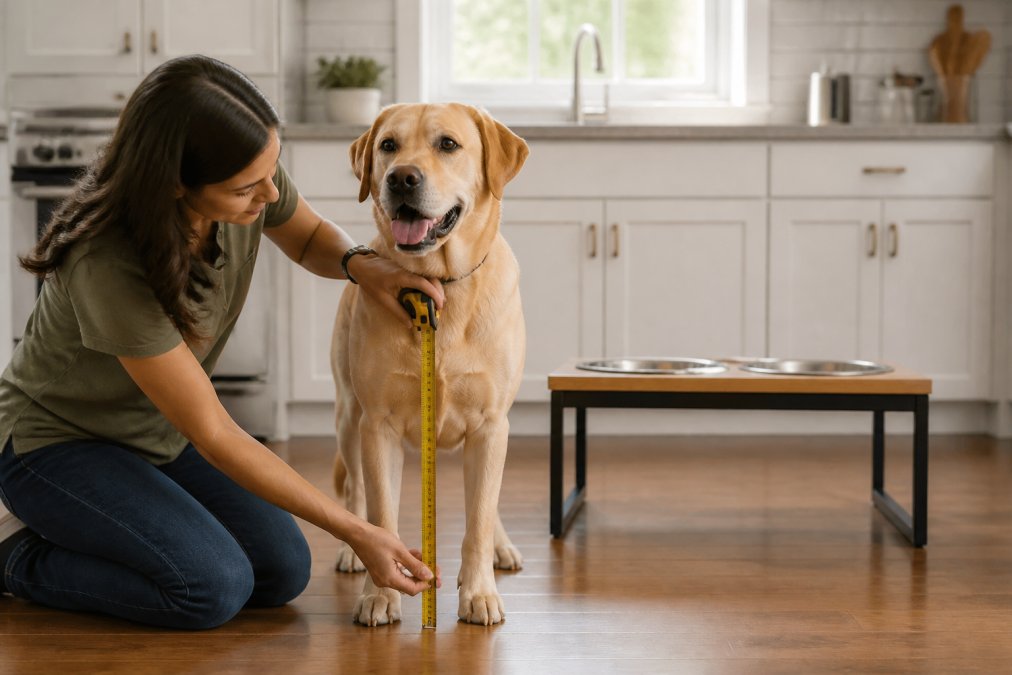
Here is the measurement routine that works in practice:
- Stand your dog on a level floor with all four paws square
- Find the lowest point of the chest, just behind the front leg
- Measure straight down to the floor with a tape measure
- Add 0 to 2 inches depending on your dog's neck length
- Set the bowl rim at that height and watch one full meal
A common mistake is a stand that is too tall. At shoulder height, the dog reaches down then lifts food upward, defeating the purpose. Ergonomic feeding means the head drops only slightly, keeping the neck neutral.
For feeding height, the lower-chest rule beats every generic sizing chart: two dogs of the same weight can need different stands because leg length and body depth vary.
Elevated Dog Bowl Bloat Risk: What the Research Says
The elevated dog bowl bloat risk question stops most owners from buying, and it deserves a straight answer. Bloat is the common term for gastric dilatation and volvulus (GDV), in which the stomach fills with gas and rotates on its own axis, trapping blood supply and cutting off the exit to the esophagus and intestine. It can progress to shock and death within hours.
The stomach sits in the abdomen suspended by two ligaments, the gastrosplenic and the hepatogastric. In a deep, narrow chest, those ligaments have more slack, so the stomach has more room to swing. That slack, plus gas accumulation and a rapid swallow of air, allows rotation. Bowl height is at most a modifier of how much air a dog swallows and how fast.
The research history explains the confusion. A widely cited study from the early 2000s reported that dogs fed from raised bowls had a higher incidence of GDV, repeated in owner surveys and breed-club questionnaires for years (PubMed). Later analyses noted the raised-bowl group was not random, owners of dogs that already ate fast, gulped, or had a family history of bloat were more likely to have bought a raised feeder. The gear correlated with risk because risk-prone owners bought the gear.
American Veterinary Medical Association resources on gastric dilatation volvulus frames GDV risk around breed, body conformation, age, and eating speed rather than bowl elevation alone. Cummings School of Veterinary Medicine at Tufts University has published on bloat risk factors in large and giant breeds, and the consistent themes are deep-chested anatomy, a first-degree relative with a bloat history, increasing age, and rapid eating. A common pattern in the literature is that eating speed and aerophagia (swallowed air) carry more weight than the height of the bowl.
What does this mean in practice? Three questions sort most dogs:
- Is your dog deep-chested? Breeds with a chest that drops well below the elbow, Great Danes, German Shepherds, Standard Poodles, Boxers, Weimaraners, Doberman Pinschers, Irish Setters, and Greyhounds, carry the conformation that makes GDV possible. If yes, proceed carefully.
- Does your dog gulp? A dog that finishes a meal in under a minute, or that swallows visible air, is a higher-risk eater regardless of bowl height. Slowing the meal is the higher-yield intervention.
- Is there a family history? A first-degree relative with a confirmed GDV episode is one of the strongest risk markers reported in breed studies. If yes, talk to your veterinarian before changing anything about feeding.
A small or medium breed with a round or shallow chest, no gulping habit, and no family history is unlikely to face meaningful GDV risk from elevation. A deep-chested, fast-eating dog gets no protective evidence from elevation, and it may not be neutral, so that decision belongs with your veterinarian, not a product page.
A practical middle path: keep the bowl at lower-chest height for comfort, add a slow-feeder insert to cut eating speed, and split the daily ration into two or three smaller meals. That addresses what the research flags, speed and meal volume, while giving an arthritic or senior dog a tolerable posture.
How to Choose a Dog Bowl for Senior Dogs
Choosing a dog bowl for senior dogs comes down to three factors: reach, stability, and grip. Older dogs often carry arthritis, joint stiffness, or reduced neck mobility, and floor-level bowls force them into a position their body no longer tolerates.
Start with a height that lets your senior dog eat without crouching. A stand bringing the rim to lower-chest level reduces neck strain and takes pressure off the front joints. Orthopedic support during meals matters more than most owners realize, especially with hip or elbow issues.
Then check the base. A wide, weighted base stops the bowl sliding when your dog leans in. Bowl stability keeps the station in one place, less scrambling, less stress.
Sanitation is the third piece. Senior dogs have weaker immune responses, so dishwasher-safe stainless steel or ceramic bowls beat scratched plastic that traps bacteria. Swap water daily and wash food bowls after every meal.
If your dog has been diagnosed with megaesophagus, a condition where the esophagus loses muscle function, follow your veterinarian's specific feeding instructions rather than a general height rule.
Breed-Specific Feeding: Deep-Chested Dogs vs. Small Breeds
Most guides generalize about bowl height. The useful version breaks it down by body shape, because the anatomy that determines the right setup is not weight, it is chest depth, leg length, back length, and airway structure. Four conformation groups cover nearly every dog.
Deep-chested breeds. Great Danes, German Shepherds, Standard Poodles, Boxers, Weimaraners, Doberman Pinschers, Irish Setters, Greyhounds, and Saint Bernards carry a chest extending well below the ribcage and a narrow abdominal cavity, giving the stomach more room to swing on its ligaments, the precondition for GDV. These dogs also eat enthusiastically, so the priority is eating speed, not height. A slow-feeder insert with a moderate lower-chest stand, plus two or three smaller meals instead of one large one, addresses what the veterinary literature flags. Do not buy a tall stand hoping it prevents bloat; the evidence does not support that, and a too-tall stand makes the dog reach and gulp more air.
Chondrodystrophic small breeds. Dachshunds, Shih Tzus, Basset Hounds, Pembroke Welsh Corgis, and Pekingese have short legs and disproportionately long spines. A tall stand forces them to crane upward, loading the thoracic and lumbar spine in the posture their anatomy tolerates worst. Floor level to about two inches is usually correct, paired with a non-slip mat so the dog does not splay its legs. With a diagnosed intervertebral disc issue, ask your veterinarian before adding any elevation.
Brachycephalic (flat-faced) breeds. French Bulldogs, English Bulldogs, Pugs, Boston Terriers, and Boxers (both deep-chested and brachycephalic) have compressed airways. They already work harder to breathe while eating, and a bowl forcing the neck into extension can narrow the airway further. A low, wide bowl that lets the dog eat with the head slightly down and the neck neutral is usually most comfortable. Watch for noisy breathing, gagging, or regurgitation during meals, airway signs warranting a veterinary conversation.
Giant and large breeds with joint issues. Great Danes, Mastiffs, Newfoundlands, and older Labrador Retrievers often carry hip or elbow arthritis alongside their size. Lower-chest height genuinely helps by removing the deep crouch that loads the front joints. Pair the stand with a weighted or rubber-ringed base so a heavy dog leaning in does not slide the station.
| Conformation Group | Example Breeds | Recommended Bowl Height | Primary Concern | Best Pairing |
|---|---|---|---|---|
| Deep-chested | Great Dane, German Shepherd, Standard Poodle, Boxer | Lower chest, moderate | GDV risk, gulping | Slow-feeder insert, split meals |
| Chondrodystrophic (long-back, short-leg) | Dachshund, Shih Tzu, Corgi, Basset Hound | Floor to 2 inches | Spinal strain from reaching up | Non-slip mat |
| Brachycephalic (flat-faced) | French Bulldog, Pug, Boston Terrier | Low and wide | Airway compression during eating | Wide shallow bowl |
| Giant/large with joint issues | Mastiff, Newfoundland, senior Lab | Lower chest | Hip and elbow loading | Weighted base |
A note on veterinary guidance versus owner experience: veterinarians tend to frame elevated bowls around the bloat question and often recommend against them for deep-chested dogs, while owners of arthritic seniors and large breeds frequently report that a raised bowl visibly reduces mealtime discomfort. Both can be true, the veterinary caution is about a rare, catastrophic outcome; the owner report is about daily comfort. Separate the goals: use elevation for comfort in dogs whose conformation does not carry GDV risk, and speed control plus meal splitting for dogs whose conformation does.
The veterinary recommendation that survives every breed breakdown is the same: match the setup to the individual dog, not a breed stereotype. A calm Great Dane and a frantic one need different gear, and a Dachshund with a healthy spine and one with a disc history need different gear too. Breed tells you which questions to ask; the individual dog answers them.
Slow-Feeder Inserts and Bowl Stability: Practical Pairings
Slow-feeder inserts and stable bowls solve the two problems elevation alone cannot fix: eating speed and movement.
Gulping is the behavior most linked to digestive upset in fast eaters. A slow-feeder insert adds ridges or maze patterns that force the dog to work for each bite, resulting in slower eating, less aerophagia (swallowed air), and often less post-meal discomfort.
Pairing matters. A slow-feeder insert inside a wobbling bowl creates frustration, not calm eating. Look for these combinations:
- A weighted or rubber-ringed base under a stainless bowl
- A slow-feeder insert sized to the bowl diameter, not oversized
- A stand with adjustable legs so you can fine-tune height as your dog ages
- A separate water station at a slightly lower height than the food bowl
Regurgitation after meals often points to eating too fast rather than bowl height. If your dog regurgitates regularly, slow the meal down first and talk to your vet about canine digestion and swallowing mechanics before blaming the bowl.
Pros, Cons, and When to Skip Elevated Bowls
Elevated bowls are not right for every dog. Here is the honest breakdown.
Pros:
- Less neck strain for dogs with arthritis or cervical pain
- Easier swallowing for dogs with reduced mobility
- Better mealtime comfort for senior dogs and large breeds
- Less mess when paired with a stable, wide base
- Easier for owners to clean and refill
Cons:
- Adds cost compared to a simple floor bowl
- Can be the wrong fit if sized poorly
- Not recommended for some deep-chested dogs without veterinary guidance
- Takes up more floor space than a single bowl
- Requires re-measuring as a puppy grows
When to skip elevated bowls: if your dog eats comfortably from the floor, has no joint or neck issues, and is a small breed with a long back, a floor bowl with a non-slip mat is often the smarter, cheaper choice. There is no prize for buying gear your dog does not need.
Conclusion: Making an Informed Choice for Your Dog
The benefits of elevated dog bowls for digestion 2026 come down to fit, not hype. Measure your dog's lower chest, watch how they eat, and let your veterinarian weigh in if bloat risk is a concern.
At My Store, we stock feeding and comfort essentials built for real dogs and real homes. Our products use ultra-soft & pet-safe materials, are mess-free & easy to clean, and are durable for everyday play. Pair a stand with our slow-feeder inserts to slow gulping, or add a weighted water station to keep hydration steady.
Every order ships with 24/7 customer support, 100% secure checkout, and easy 30-day returns, so you can test a setup and see how your dog responds.
Shop pet essentials now and give your dog a mealtime that actually works for their body.
Frequently Asked Questions
Do vets recommend elevated dog bowls?
Veterinary opinions vary by dog. Many vets recommend elevated dog bowls for senior dogs, large breeds, or dogs with arthritis or neck strain because raising the bowl reduces joint stress and improves posture. However, for deep-chested breeds at risk of bloat, some vets advise against elevation. The key is matching the bowl to your dog's specific health profile and confirming with your veterinarian.
Is it better for dog bowls to be elevated?
It depends on your dog's size, age, and health. Elevated dog bowls can ease swallowing, reduce neck strain, and support comfortable posture during meals. For dogs with megaesophagus or arthritis, elevation is often beneficial. For healthy, deep-chested dogs, the evidence on bloat risk is mixed, so discuss it with your vet before switching.
Do elevated dog bowls help with digestion?
Elevated dog bowls can support digestion by promoting a more natural eating posture, which may reduce gulping and aerophagia. For senior dogs or those with joint pain, easier access to food means they eat more comfortably and consistently. However, digestion benefits depend on the right height and your dog's individual needs, so measure carefully and monitor your dog's response.
How do I choose the correct height for an elevated dog bowl?
Measure your dog's shoulder height while standing. The bowl rim should sit roughly at shoulder height or slightly below, so your dog can eat with a level back and minimal neck bending. For senior dogs or those with arthritis, a slightly lower height may be more comfortable. Adjustable stands let you fine-tune as your dog's needs change.