

Alternatives to Traditional Dog Crates for Small Apartments
Table of Contents
- Why Rethink the Traditional Dog Crate?
- Furniture Style Dog Crates That Double as Decor
- Indoor Dog Playpens for Apartments: Flexible Confinement
- Pet Gates and Room Dividers for Open-Plan Layouts
- How to Crate Train a Dog Without a Crate: A Step-by-Step Approach
- Safety and Security: What to Check Before You Switch
- Conclusion: Finding Your Dog's Perfect Apartment Nook
- Frequently Asked Questions
Last Updated: September 8, 2026
Why Rethink the Traditional Dog Crate?
Traditional wire dog crates solve a real problem: they give your pup a secure den and keep them out of trouble when you're not watching. But in a small apartment, that bulky metal cage eats up precious floor space and clashes with your decor. Alternatives to traditional dog crates for small apartments offer the same peace of mind without turning your living room into a holding pen. This guide from My Store breaks down the best crate-free options.
The key shift is moving from the idea of a cage to the concept of a designated dog nook. A nook respects your dog's natural den instinct while blending into your home. Below are five practical strategies that balance safety, training, and aesthetics.
Furniture Style Dog Crates That Double as Decor
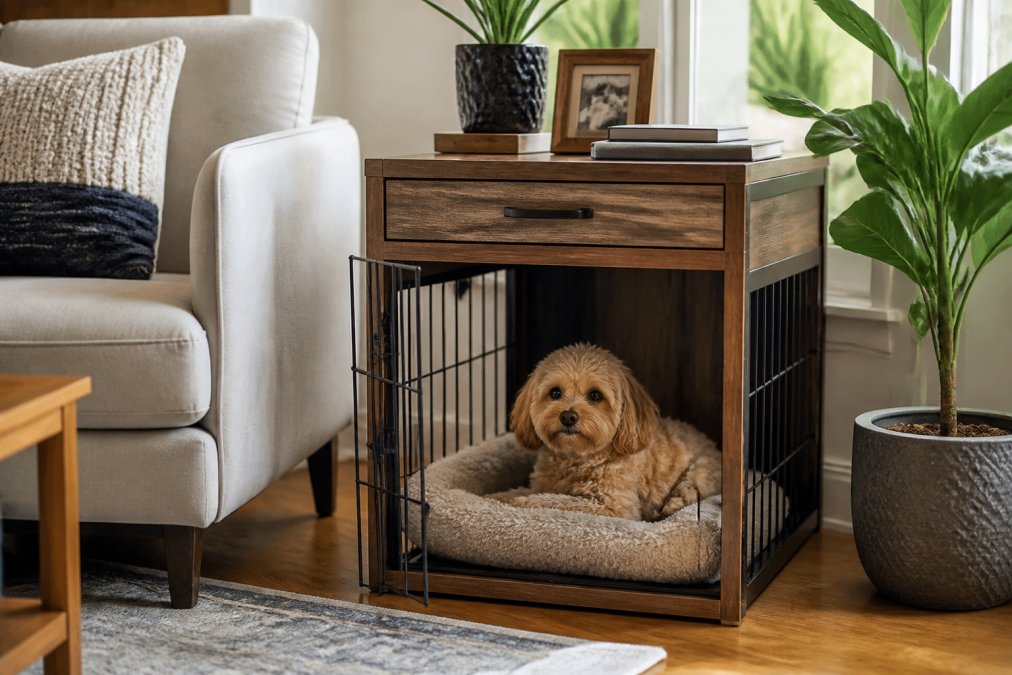
The most popular upgrade for apartment living is the furniture-style dog crate, which hides your pet's space inside a piece of decor. These units look like end tables, nightstands, or media consoles, but they contain a comfortable, enclosed area where your dog can retreat.
Furniture-grade options range from simple wooden boxes with a door to elaborate pieces with removable bowls and cushion inserts. They work especially well for dogs that already accept confinement, since the enclosed space mimics a den. The trade-off is weight and portability; these pieces are heavy and not meant to be moved daily. Most are also less ventilated than wire crates, so they suit calm, short-haired breeds better than heavy shedders or breeds prone to overheating.
For a budget-friendly take on this idea, My Store carries a range of semi-enclosed pet houses that deliver the same "hideaway" feel without the furniture price tag. The All-Season Semi-Enclosed Dog House at $34.46 is assembly-free, machine washable, and comes in sizes up to XXL for dogs within 50 lbs, making it a smart first step before you invest in a permanent furniture piece.

Indoor Dog Playpens for Apartments: Flexible Confinement
If your dog needs more room to stretch than a crate provides, an indoor exercise pen is the middle ground between total freedom and a locked cage. Indoor dog playpens for apartments come in foldable metal or fabric panels that you can arrange into a square, rectangle, or freeform shape to fit your floor plan. They are genuinely portable: fold them flat for storage or move them to follow the sun.
Playpens shine for puppies mid-house-training, for dogs that need supervised freedom while you cook, or for owners who want a safe zone that isn't a locked box. The downside is that most pens are not chew-proof; a determined adult dog can climb or push through lightweight panels. Look for pens with heavy-gauge metal and a floor anchor if your dog is an escape artist.
The Apartment-Specific Playpen Playbook
Protect the floor and the neighbors. Metal pen feet will scratch hardwood and leave dents in laminate. Place a rug, a rubber mat, or interlocking foam floor tiles underneath the entire footprint of the pen. This protects your security deposit and dampens the sound of your dog's nails clicking on the floor, a top complaint in multi-unit buildings.
Choose a shape that fits your floor plan, not the pen's default square. Most pens fold into a rectangle or square, but you can often reconfigure the panels into an L-shape to tuck into a corner. Measure your available floor space first, then count panels: a standard 8-panel pen at 24 inches per panel creates a 48-by-48-inch square, roughly the footprint of a loveseat.
Anchor it for safety, not just for escape. A dog that jumps against the side of a pen can tip it over, which is both a safety hazard and a noise nightmare for the unit below you. Use zip ties or carabiner clips to secure the pen to a heavy piece of furniture, or buy rubber floor grips that hold the panels in place without drilling.
Manage the noise of the pen itself. Metal pens rattle when a dog bumps against them. Wrap the bottom rail of each panel with pipe insulation foam or adhesive felt strips to mute the sound.
The vertical space angle. In a small apartment, floor space is at a premium. Pair the pen with a wall-mounted or over-the-door hook to hold your dog's leash, treats, and toys.
Pet Gates and Room Dividers for Open-Plan Layouts
For dogs that are already trustworthy alone but need boundaries, pet gates and room dividers offer the least restrictive option. A pressure-mounted or hardware-mounted gate across a hallway or doorway turns your whole living room into a dog-safe zone, blocking off the kitchen, bedroom, or balcony.
Gates are also the most apartment-friendly option because they are non-permanent and rental-friendly. Most install without drilling, using pressure mounts that leave no marks on the walls. Stair gates double as room dividers, and tall, free-standing mesh dividers can section off a dog nook in a studio without touching the walls.
How to Crate Train a Dog Without a Crate: A Step-by-Step Approach
Many owners worry that skipping the crate means skipping the training. In fact, you can crate train a dog without a crate by teaching the same skills: settling, boundary respect, and calm confinement.
Here is a proven training protocol:
- Choose the space and set it up. Pick your dog's nook, add a comfortable bed and a chew toy, and make it inviting.
- Feed meals in the space. Place the bowl inside the pen or bed area so your dog associates the spot with positive experiences.
- Practice short, supervised sessions. Have your dog settle in the space while you sit nearby, rewarding calm behavior with treats.
- Use a release cue. Teach a word like "free" or "okay" to signal when your dog can leave, so they learn to wait for permission.
- Extend duration gradually. Add a few minutes each day while staying in the room, then begin stepping out of sight for short intervals.
- Introduce separation in small doses. Leave for 5 minutes, return, and reward. Slowly increase your time away to build your dog's tolerance.
- Use positive reinforcement throughout. Never use the space as punishment; it must remain a happy den.
Barrier-respectful training of this kind builds real calmness, not just physical restraint. The table below summarizes how each alternative maps to your dog's needs:
| Alternative | Best For | Setup Effort | Space Needed | Rental Friendly |
|---|---|---|---|---|
| Furniture Crate | Dogs that accept den confinement | Low, one-time | Medium footprint | Yes |
| Exercise Pen | Puppies, supervised freedom | Medium, foldable | Flexible, can be large | Yes |
| Pet Gates/Dividers | Trustworthy dogs needing boundaries | Low, pressure mount | Minimal | Yes |
| Semi-Enclosed Bed | Calm dogs and cats, small breeds | None, assembly-free | Very small | Yes |
| Dog-Safe Room | Fully trained dogs, long absences | High, puppy-proofing | Large | Depends |
Safety and Security: What to Check Before You Switch
Before you retire the crate entirely, run a behavioral assessment checklist to confirm your dog is ready for crate-free confinement. Watch for signs of separation anxiety: destructive chewing near doors, excessive barking when you leave, or house-training accidents in a dog that was previously reliable.
Check the physical safety of your setup. Ensure any playpen panels are secure and free of gaps where paws could get caught. Verify that furniture-style crates have proper ventilation and no sharp edges. Confirm that gates are tall enough to prevent jumping, and that your dog cannot squeeze underneath.
The Crate-Free Readiness Assessment
Use this three-part assessment to determine whether your dog is genuinely ready for a less restrictive setup.
Part 1: The Alone-Time Test. Leave your dog loose in a single, dog-proofed room for 15 minutes while you step out. Record what happens on your phone. Look for these specific behaviors:
- Pacing or panting within the first 5 minutes, which indicates acute stress
- Scratching at the door or windows, which signals barrier frustration
- Drooling or excessive salivation, a common sign of anxiety
- Destructive behavior focused on exit points (door frames, window sills)
If you see any of these, your dog is not ready for full crate-free freedom. Go back to the training protocol and extend your crate or pen sessions until your dog can settle calmly for 30 minutes without you in the room.
Part 2: The Chew-and-Destroy Inventory. Walk through your apartment at dog-eye level. Make a list of everything within reach that your dog could chew, swallow, or knock over:
- Electrical cords for lamps, phone chargers, and TV cables, bundle them with cord protectors or run them along baseboards
- Shoes and bags left by the door, move them to a closed closet
- Remote controls and glasses on low coffee tables, relocate to high shelves
- Houseplants, many common varieties (pothos, philodendron, lilies) are toxic to dogs
- Trash cans, use a lidded can or store it inside a cabinet
If your dog is a known chewer, do not rely on bitter apple spray alone. Physically remove or block access to every item on this list for the first month.
Part 3: The Rental-Unit Safety Audit. Apartment living adds a layer of safety concerns that single-family home guides ignore. Run this audit before you commit to a crate-free setup:
- Check your lease. Some landlords and building management companies have breed restrictions or require dogs to be confined when unsupervised (hud.gov). A crate may be a lease requirement, not just a training tool. Review your lease before you remove the crate from your routine.
- Inspect your windows. If you plan to use a dog-safe room or a gated area near a window, verify that all windows have secure screens and that the window stops prevent your dog from pushing the sash open. In older buildings, window screens may be loose or missing entirely.
- Identify your smoke and carbon monoxide detectors. A crate-free dog has more freedom to investigate, so confirm that all detectors are functional and that your dog cannot accidentally trigger them by jumping up. If you have a high-energy dog, consider a detector with a hush button to avoid neighbor complaints.
- Plan for emergencies. In a fire or other emergency, you need to evacuate quickly with your dog (ready.gov). A crate-free setup means your dog may be hiding under a bed or in a closet. Practice a recall cue and keep a leash and carrier by the door. Let your building's management know you have a pet so they can assist in an evacuation.
- Soundproof your setup. If your dog will be in a gated room or a pen while you are out, test the noise level from the hallway or the unit below. A dog that barks or paces on a hard floor can create a noise complaint even if the behavior is mild. Add rugs, felt pads, and white noise machines to mask the sound and keep the peace with your neighbors.
Run this full assessment every few months. As your dog matures, their readiness level will change. A 6-month-old puppy that needs a pen may be a 2-year-old adult that can handle a gated room.
Conclusion: Finding Your Dog's Perfect Apartment Nook
Switching from a traditional wire crate to a crate-free setup is about respecting both your dog's instincts and your living space. The right choice depends on your pup's training level, your apartment's layout, and how much supervision you can provide. Start with the least restrictive option your dog can handle, and use positive reinforcement to build good habits gradually.
At My Store, we focus on products that make pet care effortless and stress-free. Our ultra-soft, pet-safe materials are durable for everyday play and easy to clean, while our semi-enclosed beds and houses give your dog a secure, comfortable nook that fits your decor. Shop Pet Essentials Now and find the perfect spot for your furry friend to call their own.
Frequently Asked Questions
What can I use instead of a dog crate?
Several options work well in small apartments. Furniture style dog crates blend into your decor, while indoor dog playpens offer more room to move. Pet gates can section off a safe zone, and semi-enclosed beds, like the Toast Bread Cat Bed, satisfy your dog's den instinct. The best choice depends on your dog's energy level, training, and your available floor space.
Are playpens a good substitute for dog crates in apartments?
Yes, indoor dog playpens for apartments are excellent substitutes, especially for puppies or dogs that need more space than a traditional crate provides. They offer a larger, safer confinement area for supervised freedom. Look for foldable, portable models that are easy to store when you need your floor space back.
How do I keep my dog contained in a small apartment without a wire crate?
To contain your dog without a wire crate, use a combination of methods. A pet gate or room divider can block off a hallway or kitchen. A designated dog-safe room with a comfortable bed, like the All-Season Semi-Enclosed Dog House, gives them a space of their own. Always pair physical confinement with positive reinforcement training.
Are there stylish dog crate alternatives that look like furniture?
Absolutely. Furniture style dog crates are designed to look like end tables, cabinets, or plant stands, so they blend with your decor rather than sticking out. For a softer look, you can use an aesthetically pleasing pet bed house. The Banana Cat Bed House is a cute, modern option that provides a cozy den-like space.