

Why Does My Dog Ignore New Toys? 7 Reasons & Fixes
Table of Contents
- Why Does My Dog Ignore New Toys? 7 Common Reasons
- Your Dog's Play Style Doesn't Match the Toy
- Health Issues and Physical Discomfort Behind Toy Avoidance
- Past Trauma, Anxiety, and Resource Guarding
- How to Teach a Dog to Play with Toys: A Step-by-Step Protocol
- Durable Toys for Aggressive Chewers: Matching Toughness to Play Drive
- The Dog Toy Rotation Strategy That Beats Boredom
- Frequently Asked Questions
Last Updated: September 10, 2026
Why Does My Dog Ignore New Toys? 7 Common Reasons
If you're wondering why does my dog ignore new toys, the problem usually isn't the toy, it's a mismatch with your dog's play style, sensory preferences, or current physical and emotional state. This guide from My Store breaks down seven common reasons dogs ignore new toys, plus a protocol to fix it.
The frustration is real. You spend money on something squeaky and bright, and your dog treats it like furniture. But a dog that ignores toys isn't broken or ungrateful. Dogs are individuals with distinct play drives, and what excites one dog can bore another completely. The American Kennel Club's guide to canine play behavior notes that play is a learned, reinforcing behavior, which means a dog that never learned to play with objects often needs help connecting the dots.
Your Dog's Play Style Doesn't Match the Toy
Play style is how a dog prefers to interact with objects and other animals. Some are chasers, tuggers, dissectors, or social players who only engage with a human involved.
A ball-chaser ignores a plush squeaker; a fabric-shredder ignores a hard rubber chew. Buying without identifying your dog's play style is the most common mistake owners make.
Watch your dog for one week and note what they do with existing toys:
- Chase and retrieve moving objects
- Tug and shake while gripping
- Chew, gnaw, or grind
- Dissect, shred, or pull stuffing out
- Carry and parade items around
- Only engage when you're actively playing too
Match the next toy you buy to the top two behaviors on that list.
Sensory-Specific Toy Preferences: Scent, Texture, and Sound
Two dogs with identical play styles can react to the same toy in opposite ways because of sensory sensitivity.
Scent. Dogs experience toys through scent first. A toy smelling of factory plastic has no appeal next to one smelling of food, you, or another animal, which is why a bin-bound toy becomes interesting after a day in your gym bag.
Texture. Some dogs prefer fleece or canvas; others want dense rubber or a crinkly liner. A dog that mouths a toy and drops it is signaling a texture mismatch, not disinterest. Offer the same shape in two textures and see which gets a second grab.
Sound. The most overlooked factor. A squeaker that delights one dog can startle another. Noise phobia, a diagnosable sensitivity to sudden or high-pitched sounds, is common in herding breeds and dogs with aversive training histories, and one bad squeaker can make a dog avoid an entire toy category (PubMed).
Try these adjustments before buying anything new:
- Rub a new toy with a treat or a bit of peanut butter
- Store new toys in a bag with your worn clothing for a day
- Offer the same shape in two textures and see which one wins
- Test a silent toy and a squeaky toy side by side
- For sound-sensitive dogs, remove or muffle the squeaker (many are accessible through a velcro pocket) and reintroduce the toy as a silent object
How to Tell Sensory Avoidance From Play-Style Mismatch
The two need different fixes. A play-style mismatch shows up as a dog who ignores one toy but engages enthusiastically with another type. A sensory issue shows up as brief engagement followed by disengagement the moment a trigger appears, the squeak, the texture, the smell.
Quick test: offer the same toy twice, once with the squeaker removed and once intact. If your dog engages with the silent version and avoids the squeaky one, it's sound sensitivity, not a play-style problem, the fix is a different toy category, not more training.
A dog that ignores every new toy regardless of scent, texture, and sound may be dealing with something deeper, which is where health comes in.
Health Issues and Physical Discomfort Behind Toy Avoidance
Physical discomfort is the most overlooked reason a dog stops engaging with toys. A dog in pain won't tell you. They'll simply stop doing the things that hurt.
If your dog used to play enthusiastically and recently lost interest, book a veterinary consultation before you buy another toy. Common culprits include dental disease, arthritis, soft tissue injuries, and gastrointestinal upset.
Dental Pain, Jaw Strength, and Physical Limitations
Dental health affects how a dog grips and chews. A cracked tooth, loose molar, or gum infection turns chewing into a painful chore, so dogs with dental pain drop toys quickly or refuse firm chews. Jaw strength varies enormously by breed and age: a weak jaw can't work a dense rubber toy, and a strong jaw will destroy a soft one in minutes. Match toughness to jaw strength, not to the label on the package.
Watch for these signs:
- Dropping toys immediately after picking them up
- Chewing on one side of the mouth only
- Drooling more than usual during play
- Reluctance to pick up hard objects
- Yelping or flinching when gripping
Canine Cognitive Dysfunction and Senior Dog Health
Canine cognitive dysfunction (CCD) is a progressive condition in older dogs affecting memory, learning, and engagement, similar to dementia in humans (vcahospitals.com). A senior dog ignoring toys they once loved may be showing early CCD, not simple disinterest.
Senior dog health requires a different approach to enrichment. Shorter sessions, softer textures, and scent-based play often work better than high-energy games. Puzzle feeders that release small treats can rebuild engagement without demanding physical effort.
Past Trauma, Anxiety, and Resource Guarding
Anxiety and past trauma can suppress play entirely. A rescue dog punished for chewing, or one raised with no toys, may not know toys are safe. Play requires a relaxed parasympathetic state, and a dog stuck in low-grade stress can't shift into the loose, bouncy posture play demands, which is why a nervous dog ignores a toy that otherwise matches their play style.
Resource guarding is related but distinct. A dog that guards food, beds, or people may avoid toys because possession has led to conflict. Never punish guarding, it escalates. Instead, manage the guarded resource (feed in a closed room, remove high-value chews when unsupervised) while working on toy engagement separately.
A Step-by-Step Desensitization Protocol for Toy-Avoidant Dogs
Here's a concrete protocol you can run over two to four weeks. Run one session per day, three to five minutes maximum, and stop before your dog shows any stress signal (lip licking, yawning, turning away, stiffening).
Week 1, Neutral presence. Place the toy six feet away. Sit nearby and read or scroll your phone. Don't look at, point at, or encourage the toy. Reward any voluntary glance toward it with a treat tossed away from the toy. Goal: the toy predicts good things without pressure.
Week 2, Curiosity. Move the toy to three feet away. Reward any sniff, any step toward it, any ear flick in its direction. Still no grabbing. If your dog grabs it on their own, great, mark and reward, then end the session.
Week 3, Contact. Place the toy between you and your dog. Reward nose contact, then paw contact, then mouth contact in that order. Mark ("yes") the instant contact happens, then deliver the treat away from the toy so the dog doesn't feel pressured to defend it.
Week 4, Movement. Once contact is reliable, drag the toy slowly along the floor for two to three inches. Reward any tracking or pounce. Introduce a short toss only after your dog is confidently grabbing a stationary toy.
Why This Works When "Just Play With Your Dog" Doesn't
Desensitization lowers the toy's intensity below the threshold that produces fear. Positive reinforcement builds a new association: toy predicts treat, treat predicts safety. Reward curiosity before contact, contact before gripping, gripping before sustained play. Most dogs progress in one to three weeks; trauma-history dogs may take longer, which is normal.
With rescue dogs, the toy often isn't the trigger, your expectation is. Leaning in, making eye contact, and urging the dog to grab adds social pressure to an uncertain situation. The protocol works because it removes you in week one and reintroduces involvement only once the toy is neutral.
How to Teach a Dog to Play with Toys: A Step-by-Step Protocol
Teaching a dog to play with toys is a structured process built on desensitization and positive reinforcement, not a single introduction. It works for puppies, adult rescues, and senior dogs alike.
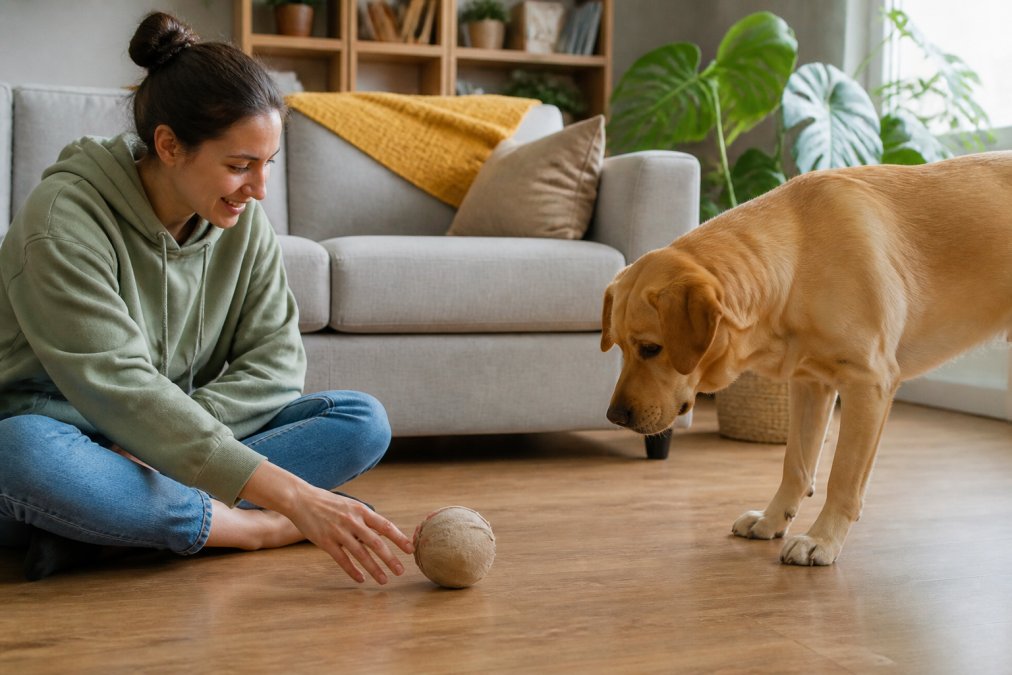
Run one session per day, five to ten minutes each. Stop while your dog is still interested.
- Clear the room. Remove other toys, food bowls, and distractions so the new toy is the only option.
- Introduce scent first. Let your dog sniff the toy without any pressure to grab it.
- Trigger prey drive gently. Drag the toy slowly along the floor, mimicking prey movement.
- Reward any contact. The moment your dog's nose or paw touches the toy, mark it and reward.
- Add movement, not noise. Once contact is consistent, introduce a short toss or wiggle.
- End on a win. Stop the session after a successful interaction, not after a failure.
- Repeat daily. Consistency matters more than session length.
Desensitization and Positive Reinforcement Techniques
Desensitization means gradually exposing your dog to the toy at an intensity low enough that no fear response appears; positive reinforcement means every small step toward engagement earns a reward. Pair them by rewarding curiosity before contact, contact before gripping, and gripping before sustained play.
Durable Toys for Aggressive Chewers: Matching Toughness to Play Drive
Durable toys for aggressive chewers solve toy fatigue from a different angle: they survive long enough for a strong-jawed dog to build a play habit. A toy that falls apart in ninety seconds teaches your dog that engagement is pointless.
Match toughness to play drive, not to size. A medium dog with a high prey drive needs a tougher toy than a large dog that plays gently.
My Store's Bite-Resistant Cartoon Pet Dog Toy is built from heavy-duty canvas for exactly this reason. At $14.98, it's designed for dogs that destroy plush toys in minutes, and the layered stitching holds up to repeated gripping and shaking. One customer, Lucas T., put it simply: "Best chew toy ever! My dog usually destroys toys in minutes, but this one has lasted weeks!"

Canvas works well for dissectors and tuggers. Dense rubber works better for grinders. Rope works for social players who want a partner on the other end.
The Dog Toy Rotation Strategy That Beats Boredom
A dog toy rotation strategy means keeping only a few toys available at once and swapping them on a schedule. Novelty drives engagement, and rotation restores it without buying anything new.
Toy fatigue happens fast. A toy that's been on the floor for two weeks is background noise. Put it away for ten days, bring it back, and it's new again.
The rotation that works for most households:
- Keep three to five toys out at a time
- Swap the full set every seven to ten days
- Keep one "high value" toy reserved for training only
- Wash fabric toys between rotations to reset scent
This also solves the boredom problem for dogs left alone during the workday. A rotating set of interactive toys and puzzle feeders gives a dog something to do besides wait by the door.
Age-Related Toy Transition: Puppy to Senior
Puppies need soft, oversized toys that are easy to grip and safe for emerging teeth. Adults need toys matched to jaw strength and play drive. Senior dog health calls for lighter, softer, scent-forward options.
Plan the transition around these markers:
- Under 6 months: soft plush, small rope, gentle tug
- 6 to 18 months: durable chew, fetch, puzzle feeders
- 2 to 7 years: match to play style and jaw strength
- 8 years and up: softer textures, scent-based play, shorter sessions
Don't wait for a dog to stop playing before you change the toy type. Transition proactively at each stage and you'll avoid most toy-fatigue plateaus.
Most owners assume a disinterested dog is picky. Usually it's the opposite: the toy doesn't match the dog's play style, sensory preferences, or physical ability, so the dog stopped trying. Fix the match, and most dogs re-engage within weeks.
My Store builds pet essentials around that idea. The Bite-Resistant Cartoon Pet Dog Toy is made from durable canvas for dogs that destroy everything else, and every product in the shop is designed for paws and claws with pet-safe materials and mess-free cleanup. If you're rebuilding a dog's interest in play, start with one toy that survives the first session. Shop Pet Essentials Now and give your dog something worth grabbing.
Frequently Asked Questions
Why is my dog suddenly not interested in toys?
A sudden loss of interest often points to pain, stress, or a change in routine rather than simple boredom. Dental disease, arthritis, or an ear infection can make play uncomfortable, while a new baby, move, or schedule shift can raise anxiety. If your dog also shows reduced appetite or stiffness, schedule a veterinary consultation. Otherwise, try a dog toy rotation strategy: store half the toys away, swap them weekly, and reintroduce one at a time to rebuild novelty and engagement.
Do dogs get bored of their toys?
Yes. Toy fatigue is real, and it happens fast when the same items stay on the floor day after day. Dogs are wired for novelty and foraging instinct, so a toy that sits in plain sight stops signaling anything new. Rotating toys every three to seven days, hiding a few around the house, or using puzzle feeders with scent-based play can reset that interest. Many owners find that three to five toys in rotation outperform twenty toys left out permanently.
How do I choose durable toys for aggressive chewers?
Match material to jaw strength. Canvas and tightly stitched fabric toys hold up well for moderate chewers, while heavy rubber or nylon suits dogs that shred plush in minutes. Check for reinforced seams, no small parts that can break off, and a size large enough to prevent swallowing. Supervise the first few sessions and retire any toy with tears or exposed filling. A well-built canvas toy at a fair price often outlasts three cheap alternatives.
How can I make my dog more interested in playing?
Start with how to teach a dog to play with toys: pick a quiet room, use positive reinforcement, and keep sessions under five minutes. Wiggle the toy along the floor to mimic prey drive rather than pushing it into your dog's face. Pair the toy with treats, praise, or a favorite person. If your dog disengages, stop and try again later. For anxious dogs, a slow desensitization protocol that pairs the toy with calm praise works better than forcing interaction.