

How to Choose a Comfortable Harness for Small Dogs 2026
Table of Contents
- Why Small Dogs Need a Different Harness Approach
- Step-in vs Overhead Dog Harness: Which Design Works Better
- How to Measure a Dog for a Harness: Girth, Neck, and Chest
- Materials and Comfort Features That Matter
- Preventing Harness Chafing in Small Dogs
- Safety Features: Tracheal Collapse Prevention and Escape-Proof Design
- Anatomical Fit for Different Small Breed Shapes
- Car Safety Restraint Integration for Small Dogs
- Our Top Comfort Pick for Small Dogs
- Conclusion: Finding the Right Comfortable Harness for Small Dogs
- Frequently Asked Questions
Last Updated: September 15, 2026
Why Small Dogs Need a Different Harness Approach
Choosing a comfortable harness for small dogs in 2026 starts with one fact most owners learn the hard way: a harness built for a Labrador can actively harm a Chihuahua. Small breeds concentrate their body weight across a much smaller surface area, so every strap edge, buckle, and seam presses harder against thin skin and delicate tracheas. This guide from My Store covers fit, design, materials, and safety.
The stakes are higher than most people realize. A poorly fitted harness can restrict shoulder movement, rub raw patches under the front legs, and in the worst cases contribute to tracheal collapse, a progressive weakening of the windpipe that veterinarians commonly associate with pressure on the neck and throat area. The American Kennel Club's harness fitting guidance recommends measuring rather than guessing, because small dogs vary enormously in shape even within the same weight class.
Step-in vs Overhead Dog Harness: Which Design Works Better
Step-in harnesses win for most small dogs because they require less handling around the head and neck, which matters for breeds with sensitive throats or dogs that dislike having things pulled over their ears. An overhead harness slips over the head and typically fastens at the chest or side.
Step-in Harness Pros and Cons
Step-in harnesses have the dog place both front paws into the leg openings, then fasten across the back. They're fast to put on, which helps wiggly puppies and older dogs with limited mobility.
- Pros: No head handling, quick on-and-off, gentle on the neck, easy for arthritic dogs
- Cons: Can be fiddly to align on very small legs, some models shift during walks if the girth strap isn't snug
Overhead Harness Pros and Cons
Overhead harnesses slide over the head and clip at the chest or back. They stay put better on narrow-chested dogs because the neck opening anchors the fit.
- Pros: Secure fit on deep-chested or narrow dogs, fewer adjustment points to manage
- Cons: Head-shy dogs resist them, the neck opening must be sized carefully to avoid throat pressure
How to Measure a Dog for a Harness: Girth, Neck, and Chest
Measuring a dog for a harness takes about two minutes and a soft measuring tape. You need three numbers: girth, neck circumference, and chest depth.
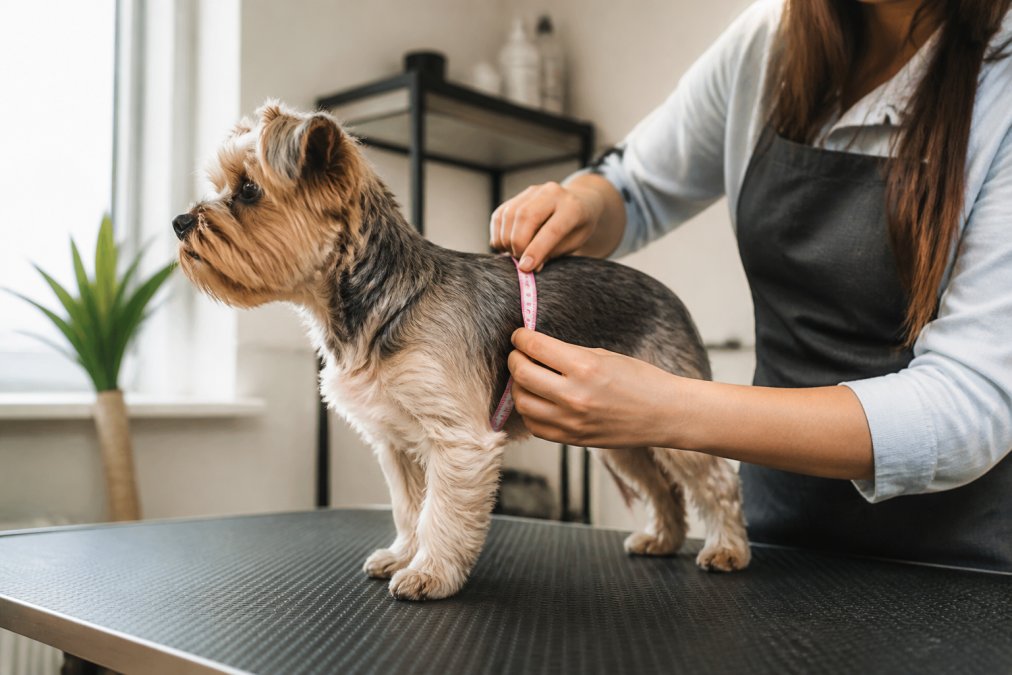
- Girth measurement: Wrap the tape around the widest part of the ribcage, just behind the front legs. This is the number that determines the harness size.
- Neck circumference: Measure around the base of the neck where a collar would sit. Add a finger's width of slack.
- Chest depth: Measure from the base of the neck down to the bottom of the ribcage. This tells you whether the chest plate will sit correctly.
Always round up to the nearest size if your dog falls between two. A snug harness that allows two fingers under every strap is the target. The Humane Society's pet care resources notes that a harness should never be so loose that a leg can slip through an opening.
| Measurement | Where to Measure | Why It Matters |
|---|---|---|
| Girth | Widest ribcage point, behind front legs | Determines base size |
| Neck | Base of neck, plus one finger | Prevents throat pressure |
| Chest depth | Neck base to ribcage bottom | Positions the chest plate |
Materials and Comfort Features That Matter
Breathable mesh and padded nylon are the two dominant harness materials; the right choice depends on your climate and your dog's coat. Both work when contact surfaces are wide enough to spread pressure.
Look for these comfort features on any harness you consider:
- Padded chest plate to distribute force away from the throat
- Adjustable straps at the chest and girth for a custom fit
- Quick-release buckle for fast on-and-off without wrestling
- Reflective piping for visibility on early morning or evening walks
Breathable Mesh vs Padded Nylon
Breathable mesh is a lightweight, open-weave fabric that allows airflow to the skin, the better pick for warm climates, thick coats, and long daily walks. Padded nylon is denser, with foam or fleece lining, offering durability and cushioning for dogs prone to friction points.
Our own pet harness product safety guidance reminder applies here: check every strap and seam monthly for wear, because a frayed edge rubs far more than a smooth one.
Preventing Harness Chafing in Small Dogs
Chafing in small dogs almost always traces back to one of three causes: a loose harness that slides, a tight harness that pinches, or a rough material edge against thin fur. For long-haired breeds and double coats, the problem is not just friction, it is matting, moisture trapping, and skin irritation that can take weeks to resolve.
The Matting Mechanism: Why Long-Haired Small Dogs Suffer Most
When a harness strap presses against long fur, it creates two problems at once: the strap rubs the hair shaft, causing breakage, and the pressure and friction make hair twist and tangle into mats. Mats are not just cosmetic, they pull on the skin with every step, creating low-grade pain and inflammation owners often mistake for "behavior problems" or "stubbornness."
Breeds at highest risk include Yorkies, Maltese, Shih Tzus, Lhasa Apsos, and any doodle mix under 20 pounds. These coats are fine, tangle-prone, and slow to dry. A harness that traps moisture against the skin, from rain, swimming, or a damp walk, creates a warm, dark environment where yeast and bacteria thrive.
A Daily and Weekly Maintenance Routine
Preventing harness-related skin problems is not about buying a different harness every month. It is about a routine that takes five minutes a day and fifteen minutes a week.
After every walk:
- Remove the harness immediately. Do not let your dog nap in it.
- Run your fingers through the coat under the chest and armpits. Feel for knots or dampness.
- If the coat is damp, towel dry the contact areas before the harness goes back on.
Every three to four days:
- Brush the chest, armpits, and back where the harness sits. Use a slicker brush for fine coats and a metal comb for doodles, especially the armpits, where hair twists easily.
- Check for redness, dandruff, or a sour smell. Any of these signals a problem.
Weekly:
- Wash the harness. Hand wash with a fragrance-free, pet-safe soap and air dry completely. Trapped grit and dried sweat act like sandpaper against the coat.
- Inspect every seam and edge. A frayed edge rubs far more than a smooth one; trim it with scissors or replace the harness.
When to Switch Harness Styles
If your long-haired small dog develops mats or redness despite a good routine, the harness style may be the problem. Match the harness to the coat:

- For double coats (Pomeranians, Shelties, Corgis): Avoid narrow straps that cut into the coat. Choose a vest-style harness with a wide, smooth chest plate that distributes pressure over a larger area, reducing friction per square inch.
- For fine, silky coats (Yorkies, Maltese): Look for a satin or smooth nylon lining; rough mesh catches fine hair. A step-in design with minimal straps beats an overhead harness whose neck opening drags across the head and ears.
- For curly coats (Poodles, Doodles): Curly hair mats fastest when compressed. Choose rounded edges and no exposed plastic buckles on the contact surface, with a padded chest plate that sits flat against the sternum.
The Two-Finger Rule Is Not Enough
Most guides tell you to check that two fingers fit under the girth strap. That is a good start, but it ignores coat thickness. For a long-haired dog, do the two-finger check with the coat compressed. If two fingers fit but the fur is visibly indented, the harness is too tight, the strap should sit on top of the coat, not press into it.
A better test: after a 10-minute walk, remove the harness and look at the fur. A visible groove or flattened band means the harness is too tight or the padding too thin. If the fur looks normal, the fit is correct.
When to See a Veterinarian
Most harness chafing resolves with fit adjustments and grooming. But see a veterinarian if you notice:
- Open sores, scabs, or bleeding
- A hot, swollen area under the harness
- Hair loss that does not grow back within two weeks
- Your dog flinching when you touch the chest or armpits
These signs can indicate a secondary infection or a contact allergy to the harness material. A veterinarian can rule out skin conditions and recommend a hypoallergenic harness or medicated shampoo.
Safety Features: Tracheal Collapse Prevention and Escape-Proof Design
Tracheal collapse prevention comes down to one rule: keep pressure off the throat. A well-designed harness for small dogs routes force through the chest and back, never the neck.
Escape-proof design matters just as much for small breeds, many of which back out of a loose harness in seconds. Look for:
- A front-clip attachment point to discourage pulling without neck pressure
- A back-clip D-ring for everyday leash attachment
- A secure closure with a quick-release buckle plus a backup strap
- Five or more adjustment points on hard-to-fit body shapes
The AVMA's guidance on pet restraint safety emphasizes that any restraint should be checked for security before every use.
Anatomical Fit for Different Small Breed Shapes
Small breeds are not one shape. A Dachshund's long spine and deep chest demand different harness geometry than a Pug's barrel chest or a Chihuahua's narrow frame. Generic sizing charts fail here, because two dogs at the same weight can have chest-to-neck ratios differing by 30% or more.
Chest-to-Neck Ratio: The Measurement Nobody Gives You
Most sizing charts only ask for girth, but the relationship between chest depth and neck circumference determines whether a harness rotates, chokes, or sits flat. The three most common small-breed profiles:
- Narrow-chested, deep-chested breeds (Chihuahua, Italian Greyhound, Whippet): These dogs have a chest that drops well below the elbow line and a neck that is nearly the same circumference as the chest. A harness with a short chest plate will slide forward and press on the throat. Look for a chest plate that extends at least 2 inches below the neck opening and a girth strap that sits well behind the armpits.
- Barrel-chested, short-necked breeds (Pug, French Bulldog, Boston Terrier): The chest is wide and round, and the neck is thick but short. A standard overhead harness can pinch the throat because there is no room for the neck opening to sit low. Choose a step-in design with a wide, low-cut chest opening and at least two inches of girth adjustment. The chest plate should be broad and flat, not curved, to avoid digging into the sternum.
- Long-backed, short-legged breeds (Dachshund, Corgi, Basset Hound): The spine is long and the ribcage is deep but narrow. A harness that concentrates force at a single back point can torque the spine. Look for a harness with a long back panel, ideally 6 to 8 inches for a standard Dachshund, that distributes leash pressure across multiple vertebrae. Avoid any harness with a single thin strap running down the spine.
How to Check Shoulder Mobility Before You Buy
A correctly fitted harness should allow full shoulder mobility. A small dog's shoulder blade sits lower and more forward than most owners realize, often just 1 to 2 inches behind the neck. If a strap crosses that area, the stride shortens.
Here is a simple test you can do at home with any harness you already own:
- Put the harness on with the girth strap snug (two fingers max).
- Have your dog stand still and watch the shoulder blade. Mark where the top of the shoulder blade sits with a piece of tape on the harness if needed.
- Walk your dog on a loose leash for 10 steps. The harness should not slide forward or backward more than half an inch.
- Watch the front legs. If the elbows swing out or the stride looks choppy, the chest strap is too far forward or too tight.
A common pattern is that harnesses marketed as "no-pull" have a front clip that sits directly over the shoulder joint. For a small dog with a narrow chest, that clip can restrict the natural forward reach of the leg. If your dog pulls, a front-clip harness can help, but check that the clip sits at least one inch below the shoulder blade, not on top of it.
Why Gait Matters More Than Padding
Padding gets all the attention, but gait restriction is the silent comfort killer. You do not need a study to see it: film your dog walking in slow motion. If the front paw does not reach as far forward as it does when naked, the harness is interfering.
The fix is not always a new harness, sometimes it is moving the chest strap back one adjustment hole or loosening the girth by half an inch. But if the chest plate is fixed too high, no adjustment helps. Anatomical fit starts with the shape of the dog, not the size on the label.
Breed-Specific Quick Reference
| Breed Shape | Key Risk | What to Look For |
|---|---|---|
| Narrow-chested (Chihuahua, Italian Greyhound) | Harness rotates, throat pressure | Long chest plate, girth strap behind armpits |
| Barrel-chested (Pug, French Bulldog) | Sternum rubbing, throat pinch | Wide low-cut chest opening, flat chest plate |
| Long-backed (Dachshund, Corgi) | Spinal torque, back strain | Long back panel (6-8 inches), multiple attachment points |
| Tiny toy (Yorkie, Maltese) | Legs slip out, harness too heavy | Step-in design, lightweight mesh under 4 oz |
If your dog falls between two shapes, prioritize the chest depth measurement over girth. A harness that is slightly too large in girth can be tightened; a harness with the wrong chest plate geometry cannot be fixed.
Car Safety Restraint Integration for Small Dogs
Car restraints for small dogs work best when the harness pairs with a seatbelt tether or crash-tested carrier. Not every walking harness is built for this, so check the manufacturer's guidance before using one in a vehicle.
A harness used in the car should have reinforced stitching at the attachment point and a wide back panel to spread crash force. The NHTSA's guidance on pet travel safety recommends securing pets so they cannot become projectiles during sudden stops. Combine a crash-tested harness with a seatbelt loop or a secured carrier for the safest setup.
Our Top Comfort Pick for Small Dogs
For most small dogs, we recommend the Reflective Breathable Dog Harness Vest - Pet Leash Set. It's built from sandwich mesh, which keeps airflow moving across the chest on warm days, and the triangular design spreads leash force evenly rather than concentrating it at a single point. The vest cut sits away from the throat, which is exactly what you want for tracheal safety in a small breed.
At $18.18, it includes a matching 1.5 m traction rope, and it comes in red, blue, gray, green, rose red, and brown. The soft, breathable construction keeps daily walks comfortable, and the even force distribution helps prevent the armpit chafing that plagues cheaper strap harnesses. For a small dog that walks every day, this combination of comfort, safety, and price is hard to beat.
Conclusion: Finding the Right Comfortable Harness for Small Dogs
With small dogs, every fitting mistake is more consequential. A harness slightly too loose or too tight on a large dog is a minor annoyance; on a five-pound dog, it's a daily source of discomfort.
At My Store, we stock pet essentials designed around comfort and safety, from breathable harnesses to ultra-soft bedding. Every product is built with pet-safe materials, mess-free cleaning, and everyday durability in mind, backed by 24/7 customer support, 100% secure checkout, and easy 30-day returns.
Get started with My Store and give your small dog a harness that fits as well as it protects.
Frequently Asked Questions
What is the most comfortable harness for small dogs?
A comfortable harness for small dogs typically features breathable mesh or padded nylon, a step-in or overhead design that avoids the throat, and adjustable straps at the chest and neck. Look for even pressure distribution across the chest rather than the neck, and a lightweight build under 8 ounces. The Reflective Breathable Dog Harness Vest from Furrygate checks these boxes with sandwich mesh and a triangular force design that spreads pressure evenly.
How do I measure my small dog for a harness?
Use a soft measuring tape to measure two areas: neck circumference at the base of the neck and chest girth at the widest point behind the front legs. If your dog is between sizes, size up. Always check the manufacturer's sizing guide because a small in one brand may fit like a medium in another.
Are step-in harnesses better for small dogs?
Step-in harnesses work well for small dogs that dislike having straps pulled over their head. They are faster to put on and often distribute pressure across the chest. However, some step-in designs can loosen over time if the buckles are not secure. Overhead harnesses offer more adjustability and tend to stay in place better during walks. The best choice depends on your dog's tolerance for handling and how often you walk.
How can I tell if my dog's harness is too tight?
You should be able to slide two fingers under every strap. If the harness leaves red marks, restricts shoulder movement, or your dog refuses to walk, it is too tight. Check for rubbing under the front legs and around the chest after each walk. A properly fitted harness for small dogs stays snug without pinching and allows full range of motion in the shoulders.