
Best Smart Feeders for Anxious Dogs: 2026 Guide
Table of Contents
- How We Chose the Best Smart Feeders for Anxious Dogs
- Quick Comparison: Top Smart Feeders for Anxious Dogs at a Glance
- Automatic Dog Feeder with Camera for Separation Anxiety: Top Picks Reviewed
- Slow Feeders vs. Puzzle Feeders: Which Actually Reduces Anxiety?
- How to Calm an Anxious Dog During Meals: Behavioral Protocols That Work
- How to Introduce a New Feeder to a Nervous Dog Without Triggering Stress
- Safety, Materials, and Cleaning: What Anxious Dog Owners Must Know
- Which Smart Feeder Should You Pick for Your Anxious Dog?
Last Updated: August 4, 2026
Anxious dogs and mealtime stress are a common combination. Finding the best smart feeders for anxious dogs means using mealtime as an active tool for behavioral health and stress reduction. At My Store, we have put together this guide to help you match the right feeder to your dog's specific anxiety triggers, with ranked picks, a behavioral protocol breakdown, and a checklist for introducing new equipment safely.
Most guides treat smart feeders as convenience gadgets. For anxious dogs, the feeder design, noise level, and feeding mechanism can either reinforce calm behavior or spike cortisol before the first kibble drops.
How We Chose the Best Smart Feeders for Anxious Dogs
Every option in this guide was evaluated against criteria that directly affect a nervous dog's experience at mealtime, with anxiety relief as the primary filter.
Selection Criteria: Anxiety Relief First, Features Second
We ranked by anxiety impact, not app functionality or hopper capacity:
- Noise output: Mechanical dispensers vary widely. A loud grinding motor can startle a noise-sensitive dog and create negative associations with feeding time.
- Dispensing consistency: Unpredictable portion drops create anticipatory anxiety. Smooth, consistent delivery reinforces calm behavior.
- Camera and two-way audio: For dogs with separation anxiety, hearing their owner's voice during meals is a documented calming tool.
- Slow-feed capability: Dogs that gulp food show signs of stress eating. A built-in slow feed option directly addresses this.
- Material safety: BPA-free, non-toxic components are non-negotiable, especially for dogs that mouth or paw at feeders.
- Ease of cleaning: Dishwasher-safe parts reduce bacterial buildup that can cause secondary health issues.
According to American Veterinary Medical Association resources on canine behavioral health, consistent mealtime routines are among the most effective environmental modifications for dogs experiencing separation anxiety.
Quick Comparison: Top Smart Feeders for Anxious Dogs at a Glance
| Feeder | Price | Camera | Two-Way Audio | Slow Feed | Dishwasher Safe | Best For |
|---|---|---|---|---|---|---|
| Furrygate H20 Auto Feeder | $179.99 | 1080p | Yes | Yes | Yes | Separation anxiety, remote monitoring |
| Furrygate Smart Auto Feeder | $97.99 | No | No | Yes | Yes | Routine building, budget-conscious |
| PetSafe Smart Feed 2nd Gen | $134.99 | No | No | Yes (15 min) | Yes | Fast eaters, Alexa households |
| Arf Pets with Voice Recorder | $69.99 | No | No | No | Partial | Owner voice comfort, basic scheduling |
Automatic Dog Feeder with Camera for Separation Anxiety: Top Picks Reviewed
Separation anxiety is the most common anxiety trigger in domestic dogs. An automatic dog feeder with camera for separation anxiety addresses it on two fronts: it maintains the feeding routine when you are away, and it lets you check in visually and verbally in real time.

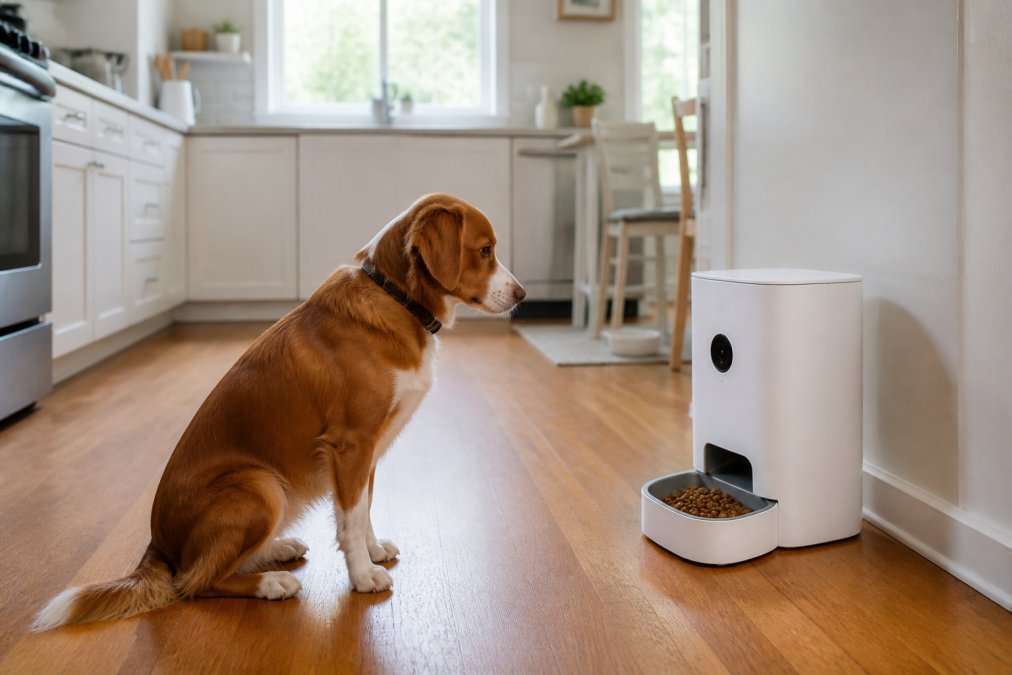
1. Furrygate H20 Automatic Pet Feeder with Camera ($179.99)
This is the top pick for anxious dogs. The Furrygate H20 Automatic Pet Feeder with Camera combines 1080p HD video monitoring with two-way audio, giving you the ability to speak calmly to your dog during meals even when you are not home. For a dog conditioned to your voice as a safety signal, this feature can lower mealtime stress noticeably.
The dispenser runs quietly, which matters for noise-sensitive dogs. Components are pet-safe and easy to clean, and the scheduling app lets you build a consistent mealtime routine, which is the backbone of any anxiety-reduction protocol.
What works: 1080p night vision, two-way audio, quiet motor, consistent portion control, BPA-free build.
What to watch: At $179.99, it is the highest investment on this list. For owners who genuinely need camera monitoring for a dog with diagnosed separation anxiety, the cost is justified.
2. Furrygate Cat & Dog Smart Automatic Pet Feeder ($97.99)
The Furrygate Cat & Dog Smart Automatic Pet Feeder is the practical choice for owners who want to establish a consistent, calming mealtime routine without the camera premium. Predictability is the single most important variable in managing food-related anxiety.

What works: Clean design, consistent scheduling, easy cleaning, pet-safe materials, strong value at $97.99.
What to watch: No camera or two-way audio. If your dog's anxiety spikes specifically during your absence and requires voice reassurance, step up to the H20.
3. PetSafe Smart Feed 2nd Generation
The PetSafe Smart Feed 2nd Generation is the right call for households already using Alexa voice control and for dogs that eat too quickly. Its Slow Feed option disperses a meal over 15 minutes, which is a meaningful behavioral intervention for stress eaters. Dishwasher-safe components make cleaning straightforward.
The absence of a camera is the main limitation for separation anxiety cases. It handles scheduling and portion control exceptionally well, but it cannot provide the visual or audio reassurance that camera-equipped feeders offer.
4. Arf Pets Automatic Pet Feeder with Voice Recorder
The Arf Pets feeder sits at the budget end at $69.99, and its standout feature is a 10-second personalized voice recording that plays at each scheduled meal. For dogs who respond to their owner's voice as a primary comfort signal, this is an effective anxiety tool at a low price point. Dual power supply (DC adapter plus battery backup) ensures feeding continues during power outages.
The limitation: no app control, no camera, and no slow-feed mechanism. This is a feeder for routine building and voice comfort.
Slow Feeders vs. Puzzle Feeders: Which Actually Reduces Anxiety?
Slow feeders and puzzle feeders both reduce anxiety, but they target different behavioral mechanisms. Slow feeders extend eating duration, activating foraging instinct and reducing cortisol spikes. Puzzle feeders add cognitive enrichment, requiring the dog to manipulate the feeder to release food, which mimics natural foraging behavior.
Snuffle Mats, Lick Mats, and Work-to-Eat Designs Explained
A snuffle mat hides kibble within fabric strips, requiring the dog to sniff and search. A lick mat spreads wet food across a textured surface, encouraging slow, repetitive licking that triggers a self-soothing response. Work-to-eat designs are any feeding mechanism that requires the dog to perform an action before receiving food.
According to ASPCA behavioral guidance on canine enrichment, mental stimulation through food-based enrichment is one of the most accessible and evidence-supported tools for reducing anxiety in domestic dogs.
How to Calm an Anxious Dog During Meals: Behavioral Protocols That Work
The feeder is the tool. The protocol is what makes it work. Calming an anxious dog during meals requires consistency, positive reinforcement, and a clear understanding of what is triggering the stress.
Noise-Dampening Feeder Designs and Why They Matter for Nervous Dogs
Feeder noise is a genuine anxiety trigger for sound-sensitive dogs. Mechanical dispensers that use auger-style delivery systems tend to produce a grinding or clicking sound that can startle a dog mid-meal. When evaluating feeders for a noise-sensitive dog, look for gravity-assist dispensing or belt-driven mechanisms over auger systems, rubber feet or non-slip bases that dampen vibration, and placement on a non-resonant surface. The Furrygate H20 and Furrygate Smart Feeder both use quiet dispensing mechanisms specifically designed to avoid startling nervous animals.
Integrating Smart Feeders Into a Positive Reinforcement Training Schedule
Smart feeders become significantly more effective when integrated into a positive reinforcement training schedule:
- Pair feeder activation with a verbal cue during the introduction phase. Over time, the cue alone can trigger a calm, anticipatory response.
- Use the feeder's schedule to anchor training sessions. Feed 30 minutes before a training block. A satiated dog is more relaxed and responsive to cues.
- Reward calm behavior near the feeder during off-hours. This builds a positive association with the feeder's physical presence.
- Gradually increase the distance between you and the dog at mealtime if separation anxiety is the target behavior.
How to Introduce a New Feeder to a Nervous Dog Without Triggering Stress
Introducing a new feeder to a nervous dog requires a gradual desensitization approach, not a cold swap from bowl to machine.
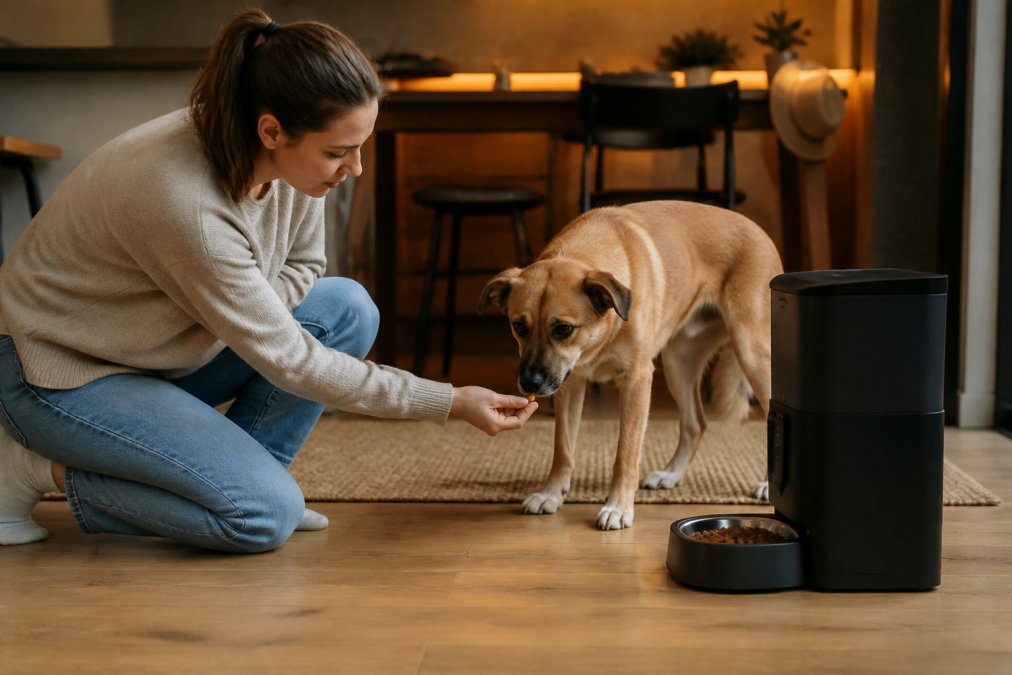
Step 1: Place the feeder in the room without activating it. Let your dog investigate at their own pace. Scatter a few high-value treats near the feeder to build an initial positive association.
Step 2: Activate the feeder without scheduling a meal. Let your dog hear the dispensing sound while you are present and calm. Pair the sound with praise or a treat from your hand.
Step 3: Hand-deliver the first few meals through the feeder. Manually trigger a dispense and let your dog eat from the feeder while you are nearby.
Step 4: Begin scheduled feeding with you present. Run the first two or three scheduled meals while you are in the room but not interacting with your dog.
Step 5: Step out of the room progressively. Once your dog is eating calmly from the scheduled feeder with you present, begin increasing your physical distance.
A common mistake is skipping steps 1 and 2. Nervous dogs often suppress stress signals until a threshold is crossed. The gradual introduction takes three to five days and prevents weeks of feeder avoidance.
Safety, Materials, and Cleaning: What Anxious Dog Owners Must Know
Safe, clean feeders are non-negotiable for anxious dogs because secondary stressors, such as unfamiliar smells from bacterial buildup or a feeder that shifts when touched, compound existing anxiety.
Materials: All feeders recommended in this guide use BPA-free, non-toxic food-contact materials. For dogs that paw or mouth at feeders, verify that the exterior housing is durable enough to withstand contact without cracking or splintering.
Cleaning frequency: Food residue in the hopper or dispensing chute is a bacterial risk. Clean the food contact surfaces every one to two weeks for dry kibble, and after every use for wet food or toppers. Dishwasher-safe components make this practical.
Choking hazard assessment: Check that the dispenser opening is sized appropriately for your dog's kibble. Oversized openings can dispense multiple pieces simultaneously, increasing the risk of gulping. Undersized openings can jam, causing frustration and anxiety when expected food does not arrive.
As FDA guidance on pet food safety and equipment standards notes, food-contact surfaces in pet feeding equipment should be smooth, non-porous, and cleanable to prevent contamination.
Which Smart Feeder Should You Pick for Your Anxious Dog?
The right smart feeder for an anxious dog depends on the specific anxiety profile:
| Anxiety Type | Best Feeder Pick | Key Reason |
|---|---|---|
| Separation anxiety (owner absence) | Furrygate H20 ($179.99) | Camera + two-way audio for real-time voice reassurance |
| Routine-dependent anxiety | Furrygate Smart Feeder ($97.99) | Consistent scheduling, clean design, reliable dispensing |
| Stress eating / gulping | PetSafe Smart Feed 2nd Gen ($134.99) | 15-minute slow feed dispense option |
| Voice-responsive anxiety | Arf Pets Voice Recorder ($69.99) | Personalized voice message at each meal |
For most anxious dogs in single-pet households, the Furrygate H20 is the best smart feeder choice because it addresses the broadest range of anxiety triggers in one unit. If the camera feature is not a priority, the Furrygate Smart Feeder at $97.99 delivers the same scheduling reliability at a lower price point.
The best smart feeders for anxious dogs are not the ones with the most features. They are the ones whose design actively supports calm, predictable, positive mealtime experiences.
For owners who want to go deeper on canine anxiety management, Veterinary Behavior Academy resources on separation anxiety treatment protocols provides practitioner-level guidance on behavioral modification approaches that pair well with structured feeding routines.
Frequently Asked Questions
Are automatic feeders actually good for dogs with separation anxiety?
Yes, when chosen carefully. The best smart feeders for anxious dogs provide a consistent mealtime routine, which is one of the most effective calming strategies for separation anxiety. Models with two-way audio let you speak to your dog remotely, while slow-feed settings prevent stress-eating. The predictability of scheduled meals gives anxious dogs a reliable anchor during the day, reducing frantic behavior around food and lowering overall stress levels while you are away.
How do I choose a smart feeder for a dog with separation anxiety?
Prioritize three features: a built-in camera with two-way audio so you can check in and speak to your dog, a slow-feed or portion-control setting to prevent gulping caused by anxiety, and a quiet motor to avoid startling nervous dogs. A battery backup is also important so feeding stays on schedule during power outages. For multi-dog homes, look for RFID or microchip-activated feeders that prevent food stealing, which can spike anxiety in subordinate dogs.
Do slow feeders mentally stimulate anxious dogs?
Yes. Slow feeders, snuffle mats, and lick mats all tap into a dog's natural foraging instinct, turning mealtime into a problem-solving activity. This work-to-eat approach provides cognitive enrichment that tires dogs mentally, which is especially useful for anxious dogs left alone. Even five to ten minutes of foraging behavior can lower cortisol levels and replace destructive habits with a calming, self-soothing activity. Combining a slow feeder with a scheduled smart feeder gives anxious dogs structure and stimulation.
Can interactive feeders replace medication for dog anxiety?
Interactive feeders and puzzle toys are behavioral enrichment tools, not medical treatments. They can meaningfully reduce mild to moderate anxiety symptoms by providing mental stimulation, routine, and calming activity. For dogs with severe separation anxiety, a veterinarian or certified applied animal behaviorist should be consulted. Smart feeders work best as part of a broader plan that may include positive reinforcement training, environmental management, and in some cases, veterinarian-prescribed support.
What materials should I look for in a safe, durable smart feeder for my dog?
Look for BPA-free plastic or stainless steel food contact surfaces, which are non-toxic and easier to sanitize. Dishwasher-safe bowls and hoppers make cleaning realistic on a busy schedule, which matters for behavioral health since bacteria buildup can cause digestive stress. Avoid feeders with small removable parts that pose a choking hazard. For anxious chewers, a feeder with a safety lock on the food container prevents your dog from forcing the hopper open between scheduled meals.
Managing a dog's anxiety through mealtime routines requires the right equipment and a consistent approach. My Store carries the Furrygate H20 and the Furrygate Smart Feeder, both built with pet-safe materials, quiet dispensing mechanisms, and designs that prioritize your dog's comfort and your peace of mind. Shop Pet Essentials Now and build the calm, predictable routine your dog deserves.
This article was written using GrandRanker