

Best Indestructible Chew Toys for Puppies
Table of Contents
- What Makes a Chew Toy Truly Indestructible
- Safe Materials for Puppy Chew Toys
- Puppy Teething Relief Toys That Last
- Size, Supervision, and Safety Essentials
- Interactive vs. Solo Play Toys for Puppies
- When to Replace Puppy Chew Toys
- Common Mistakes Puppy Parents Make
- How to Choose the Right Indestructible Toy for Your Puppy
- Frequently Asked Questions
Last Updated: September 18, 2026
What Makes a Chew Toy Truly Indestructible
The best indestructible chew toys for puppies withstand aggressive chewing without tearing, splintering, or breaking into choking hazards. They combine durable materials with design that resists teething and destructive behavior.
Durability depends on material density and construction. Puppies chew differently than adult dogs, their developing bite inhibition and sharp teeth mean a toy safe for adults may fail instantly under a puppy's focused attention.
A toy marketed as "indestructible" should survive extended supervised play without visible wear. Most puppies test limits within the first few hours, so durability must show immediately.
Safe Materials for Puppy Chew Toys
The safest materials for puppy chew toys are high-density rubber, reinforced nylon, and natural canvas, each chosen specifically for resistance to tearing while remaining non-toxic if small pieces are accidentally swallowed. However, material selection alone is insufficient; the manufacturing standards and certifications behind those materials determine whether a toy is truly safe.
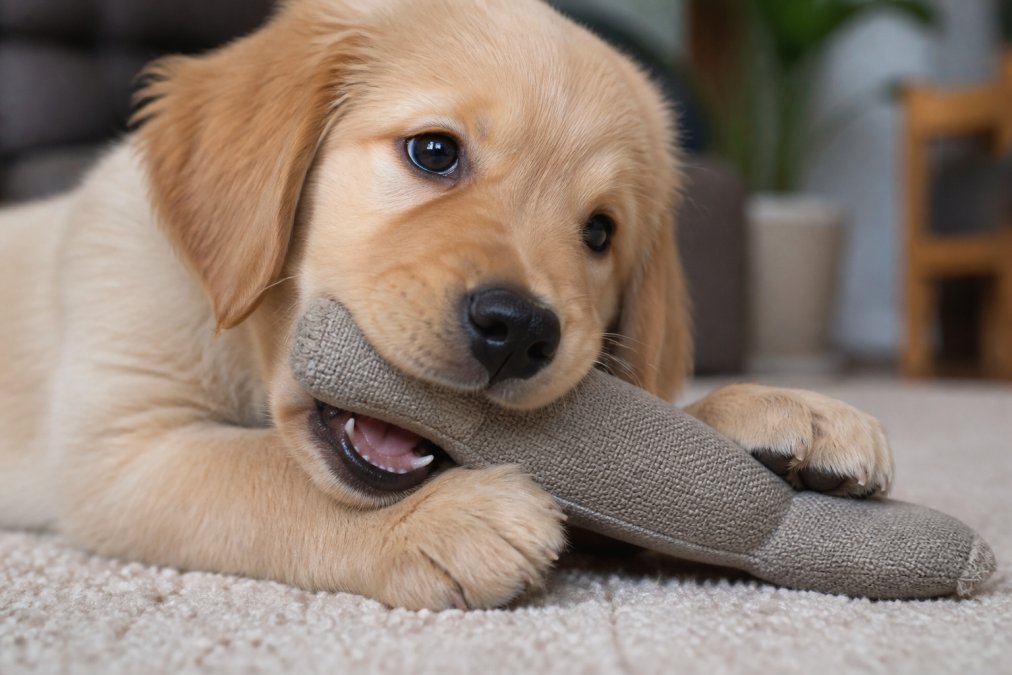
High-Density Rubber: Durability and Toxicity Concerns
High-density rubber resists puncture and tearing far better than soft rubber or latex. Look for toys made from vulcanized rubber or similar industrial-grade compounds. These materials don't degrade quickly under constant chewing, and they're designed to be non-toxic even if ingested in small amounts. The density is what matters, a thick, solid rubber toy will outlast a hollow one with thin walls.
Many rubber toys contain phthalates or BPA, endocrine disruptors that accumulate in the body. Look for toys labeled "phthalate-free" and "BPA-free," or certified by ASTM, which sets safety standards for toys.
Vulcanized rubber is safer than thermoplastic rubber because vulcanization locks in additives. If material composition doesn't specify vulcanization or phthalate-free certification, contact the manufacturer.
Reinforced Nylon: Stitching Integrity and Microplastic Risk
Reinforced nylon is engineered specifically for durability. Unlike standard fabric, reinforced nylon has tight, interwoven fibers that resist unraveling. The key is stitching integrity. Toys with double-stitched seams hold up longer because the thread itself becomes a secondary barrier to tearing. A single-stitched nylon toy will eventually fail at the seam.
Nylon sheds microplastics as puppies chew. While non-toxic in small amounts, large quantities can cause intestinal blockage in puppies under 6 months. Choose toys with tight, dense weave and inspect weekly for fiber separation.
Use nylon toys for supervised interactive play, not solo chewing, so you can remove them if fibers separate.
Natural Canvas: Weave Density and Dye Safety
Natural canvas, when tightly woven, offers surprising durability. Canvas doesn't splinter like wood and doesn't tear as easily as cotton. Canvas is also biodegradable, so if small pieces are swallowed, they break down naturally in the digestive system rather than accumulating.
Canvas toys dyed with azo dyes can break down into carcinogenic amines (pubmed.ncbi.nlm.nih.gov). Look for fiber-reactive dyes, which bond permanently and don't leach. If dye type isn't specified, choose a different toy.
Canvas toys with tight, visible weaving (you should not be able to easily separate individual threads by hand) will shed less and last longer. Avoid canvas toys with loose weaving or visible gaps between threads, as these will unravel quickly under aggressive chewing.
Materials to Avoid
Avoid soft rubber, latex, thin plastic, and loosely woven fabric, they fail in ways that create choking hazards. Also avoid toys with these characteristics:
- No material composition label: If the manufacturer doesn't disclose what the toy is made from, assume it contains unknown additives or low-quality materials.
- Strong chemical smell: A toy with a strong plastic or chemical odor may contain volatile organic compounds (VOCs) that off-gas during chewing. This is especially concerning for puppies, whose respiratory systems are still developing.
- Toys with glued-on parts: Glue can separate during chewing and be ingested. Single-piece construction is always safer than assembled toys.
- Toys with paint or coating: Paint can chip and be swallowed. If a toy has a painted surface, it should be food-grade paint that's non-toxic if ingested.
Puppy Teething Relief Toys That Last
The best indestructible chew toys for puppies during teething apply consistent pressure without breaking down. Teething peaks between 3-6 months when puppies replace baby teeth with permanent ones and seek firm gum pressure.
Textured surfaces keep puppies engaged longer during teething, providing more gum relief and reducing destructive behavior.
The ideal teething toy fits comfortably in the puppy's mouth with enough material extending beyond the teeth to grip.
Size, Supervision, and Safety Essentials
Choosing the right size toy is non-negotiable for preventing choking hazards. The toy should be large enough that it cannot fit entirely into the puppy's mouth. A general rule: if the toy can pass through a toilet paper tube, it's too small for unsupervised play.
Supervise chew sessions, especially with puppies under 6 months. Check toys every 5-10 minutes and remove immediately if you notice loose threads, cracks, or separating pieces.
For crate time, use solid, single-piece construction toys with no loose elements to eliminate ingestion risk.
Rotation prevents both boredom and excessive wear. A puppy that plays with the same toy for hours every day will wear it out faster than one that alternates between three toys. Rotation also maintains the puppy's interest, a toy that's been out of rotation for a week feels new again.
Interactive vs. Solo Play Toys for Puppies
Interactive toys (tug-of-war, fetch, treat-dispensing) involve the owner. Solo play toys (chew, puzzle) engage puppies independently. Both serve distinct developmental purposes.
Interactive Play and Bite Inhibition Training
Bite inhibition develops through interactive play. When a puppy bites too hard, stop play immediately to teach that excessive force ends the fun.
Tug-of-war toys are particularly effective for bite inhibition training because they create a scenario where the puppy must grip and pull without causing injury to a human hand. During tug-of-war, follow this protocol:
- Initiate play with clear rules: Hold the toy and let the puppy grip one end. The puppy learns that biting the toy is acceptable; biting your hand is not.
- Stop play if teeth touch skin: If the puppy's teeth contact your hand during the tug, immediately drop the toy and end the session for 30 seconds. Resume only when the puppy has calmed. This teaches cause-and-effect: hard bites end play.
- Praise gentle gripping: When the puppy grips the toy without touching your skin, provide verbal praise and continue play. This reinforces the desired behavior.
- Gradually increase difficulty: As the puppy's bite inhibition improves (typically by 4-5 months), you can increase the intensity of play slightly. The puppy learns to control force even during exciting interactions.
For tug-of-war toys, look for reinforced handles and seams that withstand sustained pulling. Avoid small handles that concentrate force; distributed handles spread wear.
Fetch toys serve a different interactive purpose: they build the puppy's focus and recall while providing cardiovascular exercise. A fetch toy must be large enough to retrieve easily (a toy smaller than a tennis ball is difficult for a puppy to grip and carry) and durable enough to survive being dropped, shaken, and retrieved repeatedly. Puppies often shake fetch toys violently; the toy must withstand this behavior without tearing or splintering.
Bite-Resistant Cartoon Pet Dog Toy →
Treat-dispensing toys used interactively (where you control when treats are dispensed) create engagement and reward-based learning. These toys work best when you're present to manage the interaction, refill treats, and prevent the puppy from becoming frustrated if they can't access the treat.
Solo Play Toys and Destructive Behavior Management
Solo play toys keep puppies occupied and provide an outlet for chewing instincts. Without them, puppies redirect chewing to furniture and baseboards.
Solo toys should offer multiple engagement modes. Treat-dispensing toys provide mental stimulation, but should allow puppies to eventually access treats independently to avoid frustration.
The most effective solo play toys for puppies under 6 months are those with varied textures and moderate difficulty. A toy that's too easy (treats fall out immediately) provides brief engagement. A toy that's too difficult (puppy cannot access treats after 10 minutes of effort) causes frustration and abandonment. The ideal solo toy requires 5-10 minutes of active engagement to fully access all treats, then provides a satisfying chewing experience once treats are gone.
Rotation of solo play toys is critical for maintaining engagement. A puppy that plays with the same toy for hours every day will wear it out faster and lose interest. Rotate between three to four solo play toys on a weekly basis. A toy that's been out of rotation for a week feels new again, which resets the puppy's engagement level.
Combining Interactive and Solo Play for Behavioral Outcomes
The best indestructible chew toys for puppies often blur the line between categories. A durable canvas toy can be used for tug-of-war with supervision and left as a solo chew toy when the owner is busy. This versatility makes the toy more valuable and extends its useful life by distributing wear across multiple use cases.
Strategically, use interactive toys during times when you're present and can actively manage the puppy's behavior (morning play sessions, after meals, before bedtime). Use solo play toys during times when the puppy must entertain themselves (while you're working, during crate time, or when you're unable to supervise). This creates a rhythm where the puppy learns that interactive play happens on a schedule and solo play fills the gaps.
Puppies that receive adequate interactive play (15-20 minutes per session, 2-3 times daily for puppies under 4 months) are significantly less likely to develop destructive chewing habits. Interactive play satisfies the puppy's need for engagement and teaches bite inhibition simultaneously. Solo play toys then serve as a maintenance tool rather than a desperate attempt to prevent destruction.
When to Replace Puppy Chew Toys
Replace a chew toy when it shows signs of structural failure, not when it simply looks worn. A toy with visible fading or surface scuffing can continue being used. A toy with loose threads, cracks, or pieces beginning to separate must be removed immediately.
Common signs it's time to replace:
- Visible tears or punctures in the material
- Loose threads that pull away easily
- Cracks that expose internal material
- Pieces breaking off during normal chewing
- Seams separating or unraveling
- Chunks missing from edges or corners
The timeline for replacement varies dramatically based on the puppy's chewing intensity and the toy's material quality. A heavy-duty toy made from reinforced nylon might last 6-8 months with a moderate chewer. The same toy with an aggressive chewer might need replacement within 4 weeks. Canvas toys typically last 2-4 months depending on chewing intensity.
Inspect toys weekly, especially during the first month of use. This establishes a baseline for how quickly wear develops. If a toy shows significant damage within the first week, it's not meeting the durability standard you need, and you should try a different material or brand.
Common Mistakes Puppy Parents Make
The biggest mistake is assuming a toy labeled "indestructible" will actually survive your specific puppy's chewing intensity. Marketing language doesn't account for individual variation. Some puppies are gentle chewers; others are aggressive destructors. A toy that works perfectly for one puppy might fail within days for another.
Another common error is buying too many toys at once. A puppy with access to five different toys will divide attention and won't develop deep engagement with any of them. Start with two or three high-quality toys and rotate them. This keeps the puppy interested while allowing you to assess which materials and styles work best for your dog.
Ignoring early warning signs is another frequent mistake. A toy with a small tear or loose thread doesn't need to be replaced immediately, but it does need to be monitored closely. Many owners wait until the toy is falling apart before removing it, which increases the risk of ingestion and choking.
Mixing toys of different durability levels creates confusion. If the puppy has access to both a durable canvas toy and a cheap plush toy, they'll often choose based on which one is more rewarding to destroy. The cheap toy provides more immediate satisfaction (it tears easily), so the puppy will preferentially chew that one. Remove toys that don't meet your durability standard rather than hoping the puppy will make the right choice.
Finally, underestimating the importance of supervision is a critical mistake. Even the most durable toy can fail unexpectedly. Supervision catches these failures before they become emergencies.
How to Choose the Right Indestructible Toy for Your Puppy
Start by assessing your puppy's chewing intensity. Does your puppy gnaw gently or attack toys with full force? Gentle chewers can succeed with softer materials; aggressive chewers need high-density rubber or reinforced nylon.
Consider the puppy's age and developmental stage. A puppy under 4 months with baby teeth has different needs than a 5-month-old with permanent teeth coming in. Teething puppies benefit from textured surfaces and the option to freeze toys. Older puppies need toys that challenge their stronger jaws.
Match the toy to your lifestyle. If you work long hours, your puppy needs solo play toys that provide extended engagement. If you're home frequently, interactive toys become more valuable. The best indestructible chew toys for puppies fit your actual routine, not an idealized version of it.
Test durability claims by starting with one toy and observing it closely for the first week. How quickly does wear develop? Where do problems appear first? This information tells you whether that material and construction style will work for your puppy long-term.
Read customer feedback carefully, but recognize that one person's "indestructible" is another person's "destroyed in two days." Look for patterns in reviews rather than individual experiences. If 20 reviewers mention the toy lasting months and 3 mention it failing quickly, the pattern suggests durability with occasional outliers. If reviews are mixed 50-50, the toy probably isn't durable enough for aggressive chewers.
Budget for quality. The cheapest toy option rarely offers the best value over time. A toy that costs $15 and lasts three months provides better value than a toy that costs $8 and lasts two weeks. My Store's Bite-Resistant Cartoon Pet Dog Toy at $14.98 combines affordability with the canvas durability that survives extended chewing sessions.

Choosing the right toy for your puppy's chewing needs prevents frustration, reduces waste, and keeps your puppy safe. The best indestructible chew toys for puppies balance durability, safety, and engagement, and they're worth the investment. The best indestructible chew toys for puppies balance durability, safety, and engagement, and they're worth the investment. Shop Pet Essentials Now and find the perfect toy for your puppy's unique chewing style.
Frequently Asked Questions
What materials are safest for indestructible chew toys for puppies?
The safest materials include high-density rubber, natural rubber, and durable canvas. Look for toys that are BPA-free, non-toxic, and specifically labeled as puppy-safe. Canvas toys like the Bite-Resistant Cartoon Pet Dog Toy ($14.98) offer durability without sharp edges or splinters. Avoid toys with loose stitching, small parts that could be swallowed, or materials that break down into pieces.
How do I know when it's time to replace my puppy's chew toy?
Replace chew toys when they show significant wear and tear, including deep cracks, missing chunks, loose stitching, or areas where the material is peeling or fraying. If your puppy can pull off pieces or if the toy has become thin enough to pose a choking hazard, remove it immediately. Even durable toys eventually wear down with aggressive chewing. Inspect toys daily, especially with heavy chewers, and replace them before they break apart and create swallowing risks.
Are nylon chew toys safe for young puppies?
Traditional nylon toys can be risky for puppies because they may splinter or break into sharp pieces that puppies can swallow. If you choose nylon toys, select high-density nylon designed specifically for puppies, and supervise play closely. Always prioritize toys labeled as appropriate for your puppy's age and size to reduce choking hazards.
What's the difference between interactive and solo chew toys for puppies?
Interactive toys like treat-dispensing or tug-of-war toys engage your puppy with you, building bond and providing mental stimulation and bite inhibition training. Solo play toys are designed for independent chewing and boredom relief when you're away. Both are valuable: interactive toys support training and supervision, while solo toys help manage destructive behavior during alone time. For indestructible options, choose solo toys made from heavy-duty materials and interactive toys with reinforced seams and secure treat compartments.