

Automatic Pet Water Fountains vs Manual Bowls for Multiple Pets
Table of Contents
- Automatic Pet Water Fountains vs Manual Bowls: Quick Comparison
- At-a-Glance Comparison Table
- How Many Water Bowls Per Pet in a Multi-Pet Home?
- Capacity and Refill Frequency for Multi-Pet Households
- How to Clean a Pet Water Fountain Without Losing Your Mind
- Pet Hydration Tips for Multi-Pet Homes
- Noise, Power Cords, and Placement Strategies
- Troubleshooting Common Fountain Failures
- Pricing Breakdown: What You Actually Pay
- Frequently Asked Questions
Last Updated: September 12, 2026
Automatic Pet Water Fountains vs Manual Bowls: Quick Comparison
Automatic pet water fountains are recirculating dispensers that keep water moving through a filter, while manual bowls are static containers you fill by hand. For a multi-pet household, the choice usually comes down to one question: how often do you want to think about water? This guide from My Store breaks down capacity, cleaning load, noise, and cost so you can pick the right setup for your crew.

Here's the short version. Fountains win on freshness and refill frequency. Bowls win on simplicity and price. The right answer depends on how many pets you have, how much space you're working with, and how much maintenance you'll actually keep up with.
Best for most multi-pet homes: an automatic pet water fountain with a filtration system and at least 2 liters of capacity. Best for one or two easygoing pets on a tight budget: a manual bowl, refilled twice daily.
Below, we'll walk through capacity math, cleaning protocols, placement strategy, and the failure points nobody warns you about.
At-a-Glance Comparison Table
The table below summarizes how automatic pet water fountains and manual bowls stack up across the factors that matter most in a multi-pet home.

| Factor | Automatic Pet Water Fountain | Manual Bowl |
|---|---|---|
| Refill frequency | Every 2-4 days (multi-pet) | 1-2 times daily |
| Cleaning frequency | Full disassembly weekly | Rinse daily, scrub every 2-3 days |
| Water movement | Continuous flow, aerated | Stagnant |
| Filtration | Activated carbon filter | None |
| Noise level | Low hum from pump motor | Silent |
| Power requirement | Corded or battery | None |
| Upfront cost | Higher | Low |
| Best for | 2+ pets, busy schedules | 1-2 pets, minimal setup |
The pattern is consistent: fountains trade a higher upfront cost and weekly maintenance for less daily effort and better water quality.
How Many Water Bowls Per Pet in a Multi-Pet Home?
The common rule is one water station per pet, plus one extra. In practice, that means a two-cat home benefits from three separate water sources, and a three-dog home from four.
Why the extra? Resource guarding. Some pets will block another from a shared bowl, especially in homes where food and water sit in the same spot. A pet that gets chased off a bowl drinks less, and reduced daily water intake is one of the earliest signs of a brewing health problem.
Here's the practical translation:
- One pet: one station is fine.
- Two pets: two stations minimum, placed in different rooms.
- Three or more: add one station beyond the pet count.
- Mixed species: separate stations, since cats and dogs often have different preferences.
Fountains change the math slightly. A single large-capacity fountain can serve as one station for multiple pets if the bowl surface is wide enough for two heads at once. Narrow-spout designs force queuing, which is exactly the behavior you're trying to avoid.
Capacity and Refill Frequency for Multi-Pet Households
Capacity is where most multi-pet households underestimate their needs. A cat drinks roughly 3.5 to 4.5 ounces of water per 5 pounds of body weight daily, and a dog's needs scale similarly with size (avma.org). Two medium dogs and a cat can easily empty a small bowl before you get home from work.
A larger reservoir solves this in two ways. First, it extends refill frequency. Second, it buffers against the day you're running late.
For reference, the American Veterinary Medical Association's pet care resources note that fresh, clean water should be available at all times, which is harder to guarantee with a bowl that runs dry by mid-afternoon.
Consider the Large-Capacity Automatic Pet Water & Food Feeder from My Store, which holds 3.8 liters and pairs a water reservoir with a food dispenser in one unit. For a multi-pet home, that capacity means refills every few days rather than twice daily, and the combined station reduces the number of separate items on your floor. It's priced at $80.76 and built for cats and dogs alike.
If you'd rather keep food and water separate, the Smart Circulating Pet Water Feeder at $46.84 uses an ABS body and a filtering dispenser to keep water moving and debris out. And for a single-pet or small-space setup, the Hanging Automatic Pet Water Kettle at $16.46 mounts to a crate or wall with a stainless steel ball valve, so it stays off the floor entirely.
How to Clean a Pet Water Fountain Without Losing Your Mind
A pet water fountain needs a full teardown and scrub once a week in a single-pet home, and every three to four days in a multi-pet household (avma.org). The reason is biofilm: a thin layer of microorganisms that forms on any wet surface, including the inside of the reservoir, the impeller housing, and the filter cartridge.

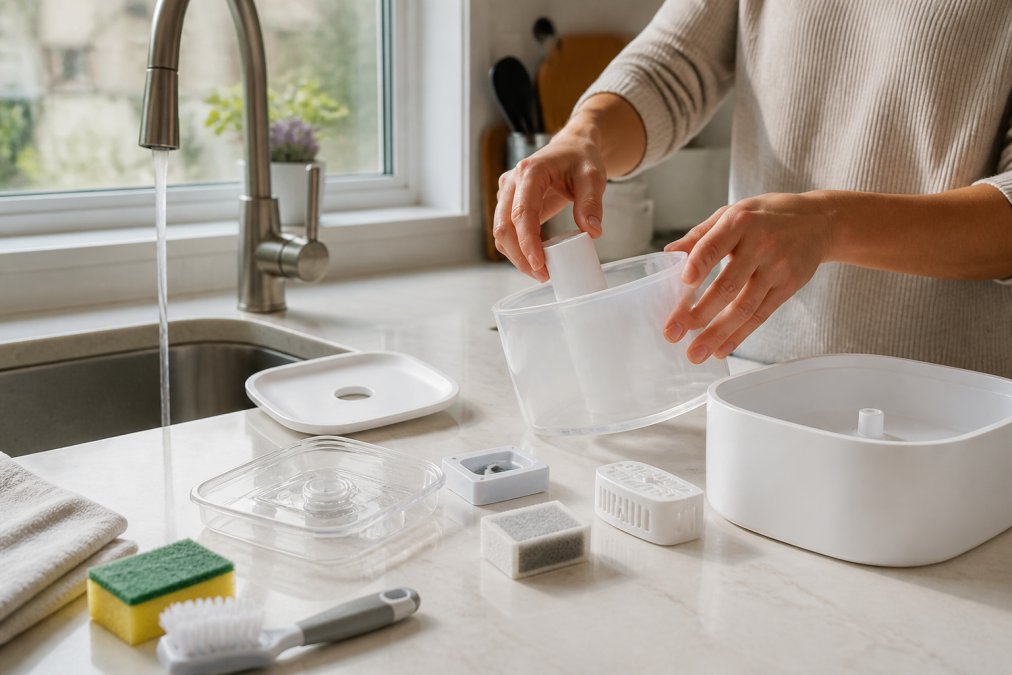
Here's the protocol that actually works:
- Unplug the unit and remove the power cord from the water source entirely.
- Disassemble fully. Reservoir, lid, bowl tray, pump housing, and impeller come apart. If a part doesn't detach, check the manual before forcing it.
- Rinse the filter separately. Rinse under cool water to knock loose hair and debris. Do not scrub an activated carbon filter; you'll destroy the media.
- Wash every hard part with warm water and a mild, pet-safe soap. A soft bottle brush gets into the pump intake where a sponge can't reach.
- Scrub the impeller well. This is the single most skipped step and the most common cause of a fountain that suddenly goes quiet.
- Rinse until no soap residue remains. Soap film changes the taste and can put pets off drinking.
- Air dry completely before reassembly. Trapped moisture between sealed parts is where biofilm starts.
- Replace the filter on the manufacturer's schedule, typically every two to four weeks.
In a multi-pet home, add one extra step: check the pump intake for hair every two to three days, not just at the weekly clean. Long-haired cats and double-coated dogs shed into the water constantly, and a clogged intake is the number one reason a fountain stops circulating.
Pet Hydration Tips for Multi-Pet Homes
Getting multiple pets to drink enough is a behavior problem as much as a plumbing problem. The mechanics are simple: pets drink more when water is fresh, moving, and easy to reach without competition.
A few approaches that hold up in practice:
- Add water sources, don't just enlarge one. Three small stations beat one giant bowl for most multi-pet homes.
- Separate water from food. Many pets drink less when water sits next to their kibble, a leftover instinct from avoiding contaminated water sources.
- Refresh bowls daily. Even a clean-looking bowl collects saliva and kibble dust within hours.
- Watch the litter box and the water level. Rising litter box output and a dropping reservoir are both signs your pets are actually drinking.
- Try a fountain if a pet ignores still water. Moving water triggers drinking behavior in many cats, which is why feline hydration is such a common reason people switch.
For cats specifically, a fountain often makes the difference. Amanda W., a My Store customer, put it plainly: "This water fountain keeps my cat hydrated all day! He loves the fresh flowing water!"
Dogs benefit too, especially larger breeds that empty a bowl in a single session. If you're not sure which direction to go, the Smart Pet Water Dispenser at $41.36 is a straightforward starting point for dogs and cats, and the Smart Circulating Pet Water Feeder at $46.84 adds the filtering and circulation loop that keeps water aerated between refills.
Noise, Power Cords, and Placement Strategies
Noise and cord placement are the two complaints that send people back to bowls. Both are solvable with a little planning.
A fountain's noise level comes almost entirely from the pump motor and from water falling back into the reservoir. A low hum is normal. A rattle, buzz, or gurgle usually means the impeller is clogged, the water level is too low, or the unit isn't sitting flat.
Placement matters more than most guides admit. Here's how to think about it:
- Keep fountains off carpet. Splash and condensation will damage the fibers over time.
- Route the power cord against a wall and out of traffic paths. Tuck it behind furniture where possible, and never run it across a doorway.
- Give each pet a clear escape route. A water station in a corner with one exit becomes a resource-guarding hotspot.
- Avoid placing fountains next to litter boxes or food bowls. Proximity increases competition and reduces drinking.
- Test the noise before committing. Plug the unit in, fill it, and stand in the room you'll actually be in. What sounds quiet in a store can be maddening at 3 a.m.
Troubleshooting Common Fountain Failures
Most fountain problems trace back to four causes: a clogged impeller, a low water level, a seated-wrong filter, or a pump that's simply reached the end of its life.
Work through this order before you assume the unit is dead:
| Symptom | Likely Cause | Fix |
|---|---|---|
| No water movement | Impeller jammed with hair | Disassemble, clean impeller well |
| Loud rattling | Water level too low | Top off the reservoir |
| Weak flow | Filter clogged or seated wrong | Rinse or replace filter |
| Pump runs but no flow | Air trapped in the line | Refill and prime the pump |
| Intermittent stop-start | Loose power connection | Reseat the cord at both ends |
| Persistent noise after cleaning | Pump motor worn out | Replace the pump |
If you've cleaned the impeller, topped the water, and reseated the filter and the unit still won't circulate, the pump is the problem. Replacement pumps are inexpensive and usually easier than buying a whole new fountain.
One more thing worth knowing: many fountains have a low-water cutoff that shuts the pump off to protect the motor. If your fountain goes silent overnight and the reservoir is nearly empty, that's the safety feature working, not a malfunction.
Pricing Breakdown: What You Actually Pay
The upfront price gap between fountains and bowls is real, but it narrows once you factor in what you replace over time.
| Option | Upfront Cost | Ongoing Cost | Best For |
|---|---|---|---|
| Hanging Automatic Pet Water Kettle | $16.46 | None | Crates, small spaces, one pet |
| Smart Pet Water Dispenser | $41.36 | None | Dogs and cats, simple setup |
| Smart Circulating Pet Water Feeder | $46.84 | Filter replacements | Multi-pet, filtration priority |
| Automatic Pet Feeder with Double Bowl | $79.44 | None | Combined food and water station |
| Large-Capacity Water & Food Feeder | $80.76 | Filter replacements | 3+ pets, high capacity |
| Manual bowl | Low | None | 1-2 easygoing pets |
A manual bowl costs less on day one. A fountain costs less in daily effort, and in a multi-pet home that effort is the thing that actually runs out.
The trade-off is honest: fountains need weekly cleaning and periodic filter changes, and they depend on either power or a battery. If you travel often or have a pet that chews cords, a manual bowl plus a second station may genuinely be the better call.
Managing water for multiple pets is less about the product and more about the routine behind it. My Store carries the pieces that make that routine easier, from the Large-Capacity Automatic Pet Water & Food Feeder with its 3.8-liter reservoir to the Smart Circulating Pet Water Feeder with its filtering dispenser and the compact Hanging Automatic Pet Water Kettle for tight spaces. Every order comes with 24/7 customer support, 100% secure checkout, and easy 30-day returns. Get started with My Store and give every pet in your home a reason to drink more.
Frequently Asked Questions
Are automatic pet water fountains better than bowls for multiple pets?
For two or more pets, automatic pet water fountains usually win on capacity and freshness. A 3.8L reservoir like the Large-Capacity Automatic Pet Water & Food Feeder covers a multi-pet household for a full day or more, while a single manual bowl needs refilling several times. Fountains also keep water moving, which limits stagnation and biofilm buildup. The trade-off is cleaning: fountains need a weekly deep clean, while bowls take seconds to rinse.
Can I have one water fountain for two cats?
Yes, but placement matters as much as capacity. Cats often resource guard shared water, so a single fountain in a high-traffic area can push the less confident cat away. Put the fountain in an open, quiet spot and add a second manual bowl in a separate room. That gives both cats a backup source without doubling your cleaning load. Watch for one cat hovering while the other waits.
How often do you need to clean a pet water fountain?
Most manufacturers recommend a full disassembly and scrub every 5 to 7 days, with a quick water swap every 2 to 3 days. In a multi-pet home, drop that to every 3 to 4 days because more pets mean more saliva, food particles and biofilm. Clean the pump impeller with a small brush each time, and replace the activated carbon filter every 2 to 4 weeks depending on how many pets drink from it.
Do automatic water fountains encourage pets to drink more?
Many pet owners report exactly that. Moving water is more noticeable and often more appealing than still water, especially to cats, who are naturally drawn to running sources. Higher daily water intake supports urinary and kidney health, particularly in cats prone to dehydration. If your pet ignores the fountain at first, run it for a few days without removing the old bowl so they can adjust at their own pace.
How many water bowls per pet should I set out?
A good rule is one water station per pet, plus one extra, spaced apart. In a two-pet home that means three stations: a fountain in the main living area and two bowls in separate rooms. This setup reduces resource guarding and gives shy pets a low-pressure option. Refill or rinse manual bowls daily, and check fountain water levels every morning before you leave.